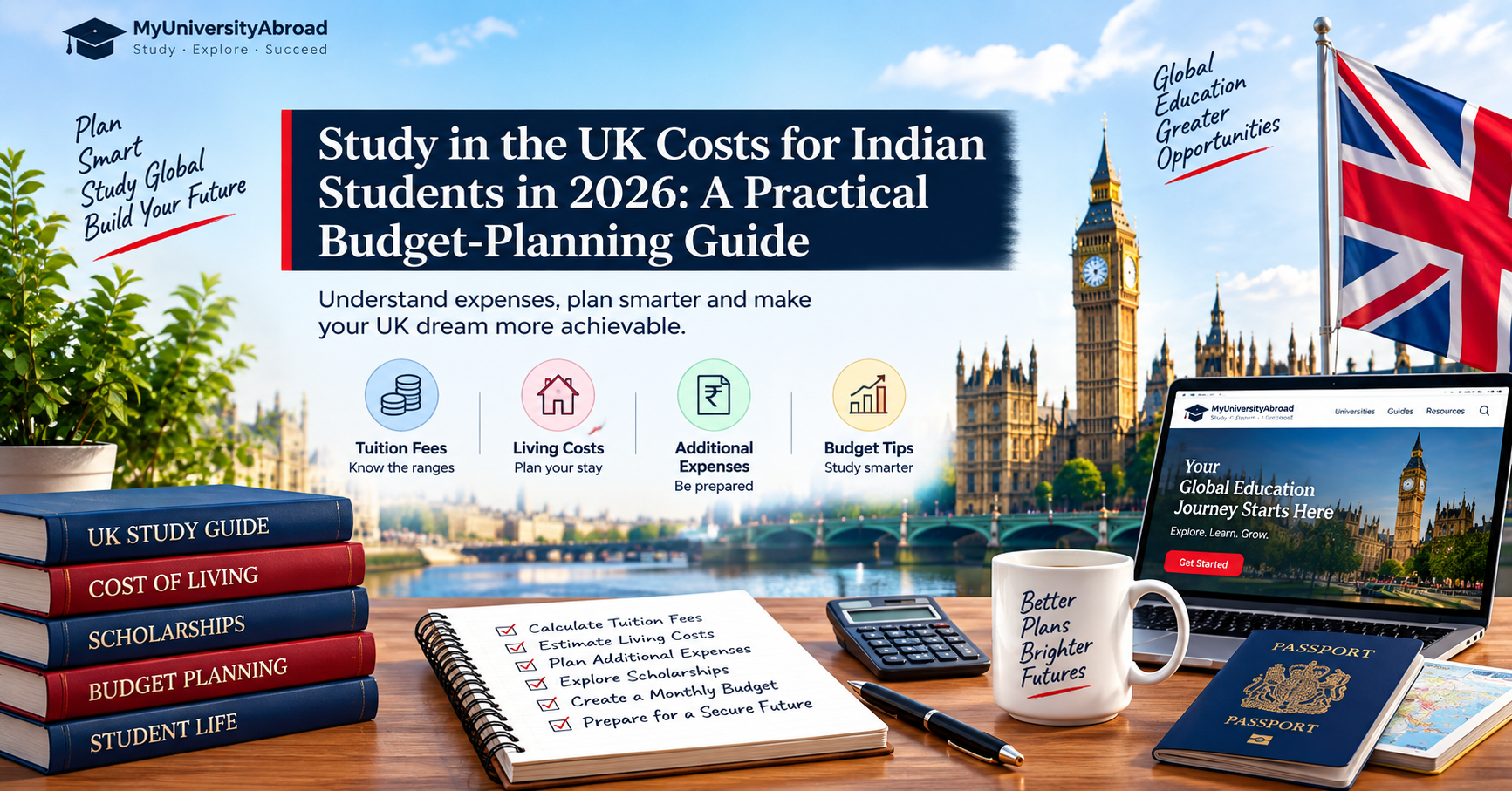
Study in the UK Costs for Indian Students in 2026: A Practical Budget-Planning Guide
 Verified read
Most cost guides stop at giving you a total number. The more useful exercise is building an actual plan around that number — knowing where the money comes from, when each payment is actually due, and where the real cash-flow pressure points sit. Here's how to plan a full UK study budget, not just calculate one.
Step 1: Know your three cost components
- Tuition: £12,000–£45,000/year depending on course level and subject, varying more by subject than by city
- Living costs: £900–£1,600/month depending on city, with London at the top of the range and cities like Belfast or Newcastle at the bottom
- Mandatory visa-related costs: roughly £3,000–£4,000 total, including the visa fee (£558), the Immigration Health Surcharge (typically £1,552 for a one-year course, since it's charged against your visa length rather than course length), and a university deposit (£2,000–£5,000, usually credited against tuition)
A realistic one-year Master's typically totals ₹35–48 lakh all-in, depending on city and course.
Step 2: Decide your funding mix before you need it
Most Indian families fund UK study through some combination of savings and an education loan, and the choice of loan structure matters as much as the total amount.
Collateral threshold: Indian public banks generally don't require collateral for loans up to ₹7.5 lakh, backed by a government credit guarantee scheme. Above that, most public sector banks require collateral — property, fixed deposits, or LIC policies — though several offer special uncollateralised schemes up to ₹40 lakh for students admitted to IITs, IIMs, NITs, or similarly ranked institutions.
Interest rates in 2026 typically range from around 8.4%–11% for secured loans at public banks, rising to 10.5%–14% for unsecured loans or NBFC products. Even a 1% difference in rate can change your total repayment by a meaningful amount over a 10–15 year tenure, so it's worth comparing more than one lender rather than defaulting to the first offer.
The PM Vidyalaxmi scheme, integrated with the government's Vidya Lakshmi portal, offers a 3% interest subsidy on loans up to ₹10 lakh for students at NAAC A/A+ or top-100 NIRF-ranked institutions, for families with income up to ₹8 lakh a year — worth checking eligibility for before assuming you need a fully commercial rate.
International lenders without a co-applicant requirement — Prodigy Finance and similar providers — are worth considering if you don't have property to pledge or a co-applicant with strong income, though their rates are typically variable and linked to international benchmark rates rather than the Indian repo rate.
The moratorium period (course duration plus 6–12 months) is when your principal repayment is paused — but interest usually still accrues during this time unless you qualify for a subsidy scheme, and unpaid interest gets added to your principal by the time repayment starts. Paying the interest as it accrues during your course, even in small amounts, meaningfully reduces your total repayment compared to letting it fully capitalise.
Step 3: Map your actual cash-flow timeline, not just your total budget
This is the step most families skip, and it's where real financial stress tends to show up — not because the total budget was wrong, but because money was needed earlier than expected.
- University deposit (£2,000–£5,000) is typically required to secure your place, often before your visa application can even be submitted — well before any loan is likely to be disbursed.
- Loan disbursement usually happens only after visa approval, not before, since most lenders want visa confirmation before releasing funds. This creates a timing gap: your university may expect first-term tuition within 30 days of enrolment, while your loan disbursement might land 5–10 working days after your visa is granted — a narrow window that needs coordinating with your bank in advance, not discovered under pressure.
- Visa fee and IHS are due at the point of your visa application, well before you travel, and need to come from funds already available (savings or an earlier loan tranche) rather than a disbursement tied to visa approval.
- Monthly living costs begin only once you've arrived, but your maintenance funds need to be held and evidenced for a continuous 28-day period before your visa application — meaning this money needs to exist and stay untouched well ahead of departure, not be treated as available for other pre-departure costs.
Building a simple month-by-month view — what's due, and from which funding source — before you commit to a university offer avoids the common trap of having sufficient total funds on paper but a genuine shortfall at a specific moment in the timeline.
Step 4: Plan your currency conversion, not just your rupee budget
Currency conversion spreads typically run 1–3% on international transfers — a real, recurring cost across tuition payments and living-cost transfers over a full degree. Once you have a confirmed offer, comparing forex providers (rather than defaulting to your existing bank) and considering a forward contract to lock in a rate can meaningfully reduce this cost over the life of your degree, particularly for a longer undergraduate programme where the exposure runs over several years.
Step 5: Build in a contingency buffer
Beyond your calculated total, it's worth planning for a buffer of roughly 5–10% of your total budget — covering things like a stronger-than-expected currency movement, an unplanned one-off cost, or a delay in loan disbursement that requires bridging with savings temporarily. Families who budget to the exact estimated total, with no buffer at all, are the ones most likely to face a genuine cash-flow crunch mid-course rather than simply a tighter year.
Frequently asked questions
How much collateral do I need for a UK education loan from an Indian bank? Generally none up to ₹7.5 lakh, backed by a government credit guarantee scheme. Above that threshold, most public banks require collateral, though some offer special uncollateralised schemes up to ₹40 lakh for students admitted to top-ranked institutions like IITs or IIMs.
When does an education loan actually get disbursed? Most Indian lenders disburse only after your UK student visa is approved, typically within 5–10 working days — which can create a tight window if your university expects tuition payment within 30 days of enrolment. It's worth confirming this timeline with your bank before accepting your university's payment terms.
Should I pay interest on my education loan while I'm still studying? It's generally worth it if you can. Interest usually continues to accrue during the moratorium period even though principal repayment is paused, and paying it as it accrues — rather than letting it capitalise into your principal — meaningfully reduces your total repayment amount over the loan's life.
What's the biggest budgeting mistake Indian families make when planning UK study costs? Treating the total cost as a single lump sum rather than mapping when each cost actually falls due. University deposits, visa fees, and maintenance fund evidencing all happen before departure and before typical loan disbursement timelines, so a family can have sufficient total funds on paper while still facing a genuine timing gap.