How Student Visa Rejection Rates Affect University Trust
 Verified read
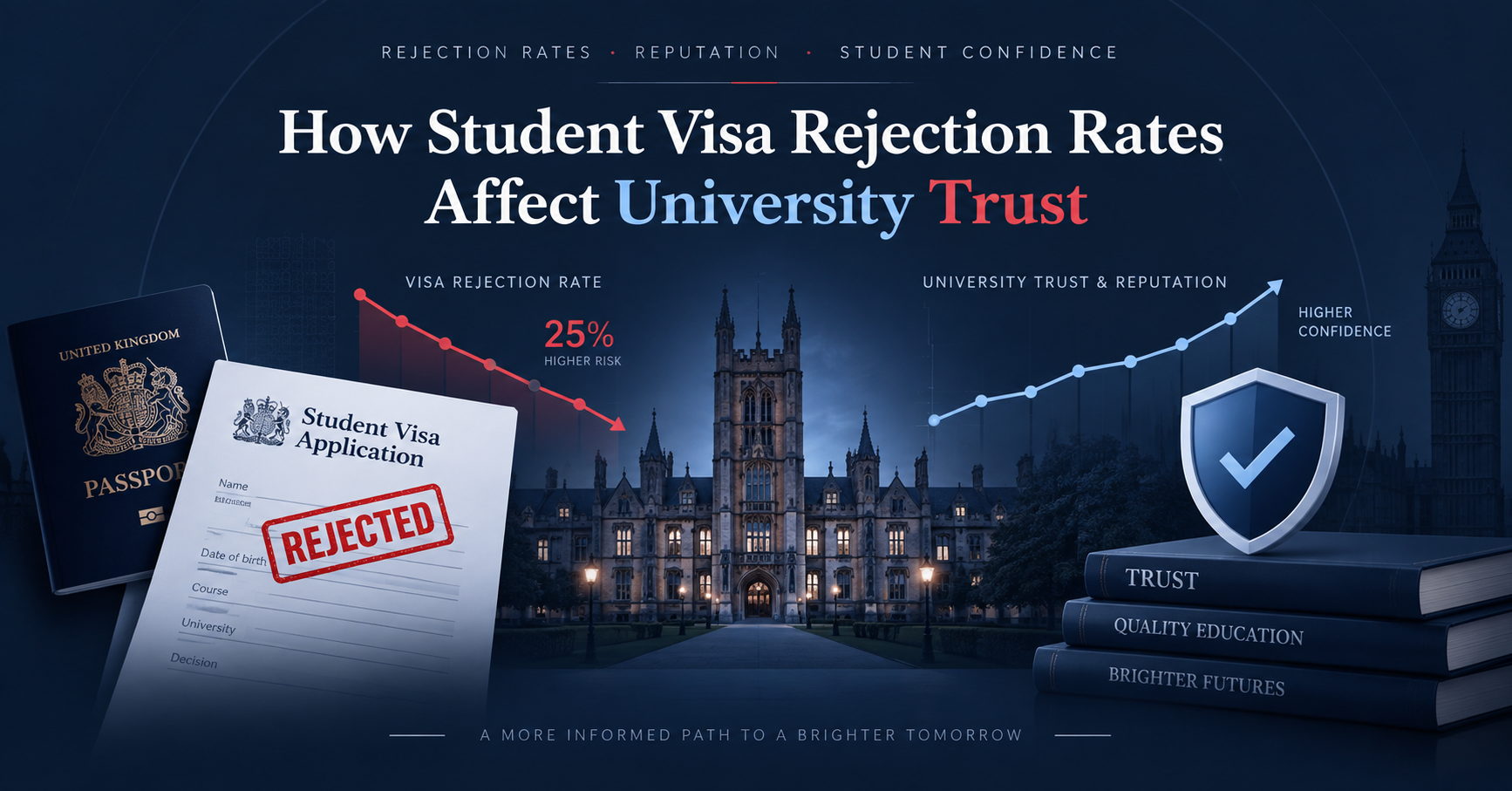
A university's visa refusal rate isn't just a statistic about past applicants — it affects the institution's standing with UKVI in ways that can indirectly touch your own application, even if your file is perfectly genuine. Understanding this connection helps explain why some signals are worth checking before you apply, and it changes what to actually do if you're the one who gets refused.
Why refusal rates affect more than the applicants they refuse
UK universities are assessed under a Red-Amber-Green (RAG) compliance system, and one of the core metrics is the institution's visa refusal rate. Crucially, this rating is set by the worst single metric, not an average — so a concentration of refusals, even from a specific source country or a specific recruitment channel, can move a university's overall compliance band. When that happens, real consequences follow: a formal engagement meeting with UKVI, a freeze on new Certificate of Sponsorship (CAS) allocation, or in more serious cases, a minimum cut to how many students the institution can sponsor going forward.
This is where it connects to you directly, even as a genuine applicant. If a university's compliance standing weakens, the practical effects — slower CAS processing, more conservative internal screening, reduced allocation for your intake — can affect students who had nothing to do with the underlying problem. This is why a university's or agent's refusal-rate trend is worth understanding as part of your own decision, not just an abstract institutional metric.
Signals worth checking before you apply
- Whether your agent is accredited under the National Code of Ethical Practice and committed to the Agent Quality Framework — since April 2026, this is directly referenced in Home Office Student Sponsor Guidance, meaning universities themselves are increasingly checking this for their own compliance protection, and you can ask the same question.
- Whether your target university has faced recent, publicised compliance action — engagement meetings, CAS allocation restrictions — which occasionally surfaces in sector press even though individual RAG ratings aren't always made public in real time.
- General refusal-rate trends for your specific nationality, published quarterly by the Home Office. A country experiencing a sharp recent spike is a useful piece of context, both for your own realistic expectations and for understanding why a specific institution might be applying extra scrutiny to applicants from that market.
What to actually do if you're refused: the real options, and their real odds
If a refusal does happen, the options are narrower and more time-critical than most people expect.
Administrative Review. This is a Home Office process for challenging a refusal specifically on the grounds of a caseworking error — not a general disagreement with the outcome. Key details:
- Deadline: 14 days if you're in the UK, 28 days if you applied from overseas — these are hard limits, not guidelines.
- Cost: £80, refunded only if the review succeeds.
- It's decided on the original evidence only — no new documents can be submitted.
- Student visa Administrative Review success rates have been notably lower than other visa categories — commonly cited in the 8–12% range, compared to somewhat higher rates for routes like Skilled Worker.
A fresh application. Given the comparatively low success rate for student visa Administrative Reviews, many advisers recommend a corrected fresh application over an AR for most student refusals — provided the specific reason for refusal can genuinely be addressed (better financial evidence, a clearer SOP, a study gap explained more thoroughly). Simply resubmitting the same application unchanged is very unlikely to produce a different result.
A full Tribunal appeal. Most student visa refusals don't carry a right to a full appeal, since this route is generally reserved for cases engaging human rights grounds. If your refusal letter does state a right of appeal, this is a more involved and slower process (commonly 6–12 months to a hearing) but allows new evidence to be submitted, unlike an Administrative Review.
The most important practical step: read your refusal letter closely for what it actually says about your right to challenge the decision, and act immediately — these deadlines run from the date the decision was served, not the date you read it, and missing them permanently forecloses that option. Given how technical and time-sensitive this process is, getting advice from a regulated immigration adviser before choosing a route is genuinely worthwhile, rather than guessing which option fits your situation.
Frequently asked questions
Does a university's visa refusal rate affect students who haven't been refused?
Indirectly, yes. A university's compliance rating can affect CAS allocation and processing for the whole institution, meaning a rising refusal rate — even one concentrated in a specific market or channel — can create knock-on effects (slower processing, more conservative screening) for other applicants at the same institution.
Should I check my agent's accreditation before applying?
Yes. Ask whether your agent is accredited under the National Code of Ethical Practice and committed to the Agent Quality Framework — this is now something universities themselves are expected to verify for their own compliance position, and it's a reasonable, specific question to ask directly.
What should I do first if my UK student visa is refused?
Read the refusal letter carefully for the specific reason given and whether it states a right to administrative review or appeal, and note the deadline exactly — it's short (14 or 28 days) and runs from the date the decision was served. Acting quickly and getting advice from a regulated immigration adviser before choosing a route is strongly recommended given how technical the process is.
Is an Administrative Review usually successful for a student visa refusal?
Success rates for student visa Administrative Reviews have generally been lower than for some other visa categories, commonly cited in the 8–12% range. Given this, and that no new evidence can be submitted during a review, many advisers recommend a corrected fresh application instead, where the underlying issue can genuinely be addressed.