
 Verified read
In today’s increasingly globalized education and employment landscape, students and professionals often pursue education in one country and later seek opportunities in another. However, differences between education systems can make it difficult for universities, employers, licensing bodies, and immigration authorities to understand foreign qualifications. As a result, many universities and organizations in the United States and Canada rely on credential evaluation processes to interpret foreign qualifications in a clear and standardized way. World Education Services (WES) helps address this problem through credential evaluation. A WES credential evaluation helps translate international academic achievements into a format that organizations in the U.S. or Canada can understand. For many students and professionals, it can be an important step toward turning an international qualification into a new academic or professional opportunity.
About World Education Services (WES)
World Education Services (WES) is North America’s trusted leader in credential evaluation services. It is a non-profit social enterprise dedicated to helping international students, refugees, and immigrants achieve their career and educational goals to study in United States or to study in Canada. World Education Services (WES) Evaluation primarily provides credential evaluation services for universities, employers, and immigration authorities in both the United States and Canada. WES was established in 1974 and has spent approximately five decades developing expertise in international education systems and credential assessment. Over the years, it expanded its work in credential evaluation and related initiatives supporting internationally educated individuals. WES celebrated its 50th anniversary in 2024.
What is World Education Services Evaluation?
WES is a major credential evaluator. WES evaluation basically evaluates academic credentials or Educational Credential Assessments (ECA), which are essential for international students applying to Canadian or US universities. The credentials evaluation by WES compares a student’s academic accomplishments to standards in the U.S. or Canada. This report helps institutions like schools, licensing boards, employers, or immigration authorities better understand educational qualifications. WES is a major credential evaluator.
Some of the major features of WES include:
-
International credential evaluation: Helps organizations understand qualifications earned abroad.
-
Document verification: WES reviews and verifies academic documents according to its requirements.
-
Multiple report types: Applicants can choose between Document-by-Document and Course-by-Course evaluations, depending on their purpose.
-
Electronic delivery: Reports can be delivered to designated institutions.
-
ICAP document storage: The ICAP package provides secure storage of verified academic documents.
-
Online application and tracking: Applicants can manage and monitor their evaluation through their WES account.
Types of WES Evaluation Reports
WES offers different evaluation options depending on the applicant’s purpose.
1. Document-by-Document Evaluation
A Document-by-Document (DxD) evaluation identifies and describes the academic credentials submitted and provides their U.S. or Canadian equivalency.
It is generally useful for purposes such as employment, immigration, and some educational applications. This type of evaluation focuses on confirming the level of your qualification rather than analysing individual subjects or grades. Because of its broader overview, the DxD report is commonly used for:
- Immigration Purposes
- Employment Applications
- First-Year College or University Admissions
In short, a DxD evaluation verifies the overall level of your education but does not provide a detailed breakdown of courses or grades.
2. Course-by-Course Evaluation
A Course-by-Course (CxC) evaluation provides a more detailed analysis. In addition to credential equivalencies, it examines individual courses and can include information such as credits, grades, and a GPA calculated on a 4.0 scale.
This type is commonly useful when an institution or professional licensing body needs detailed information about an applicant's academic coursework. A CxC evaluation usually includes:
- Individual Course Listings
- Converted Semester Credits
- Grade Conversions
- A Calculated Grade Point Average (GPA)
Because of this detailed breakdown, the CxC report is widely required for graduate program admissions, professional licensing boards, and credit transfer evaluations. Universities often request this report to better understand your academic performance and determine whether certain credits can be transferred to their programs.
3. Educational Credential Assessment (ECA)
For certain Canadian immigration purposes, WES provides an Educational Credential Assessment (ECA). An ECA assesses foreign education for Canadian immigration purposes and is different from a standard WES evaluation.
Therefore, applicants should select the report specifically required by the organization or immigration program they are applying to. It is necessary for Canada PR (Express Entry) and various Provincial Nominee Programs (PNP).
4. ICAP
WES also offers the International Credential Advantage Package (ICAP) with eligible standard evaluations. ICAP includes secure storage of verified academic documents, making it easier to send the evaluation and verified documents to additional recipients in the future.
WES Basic vs. WES ICAP
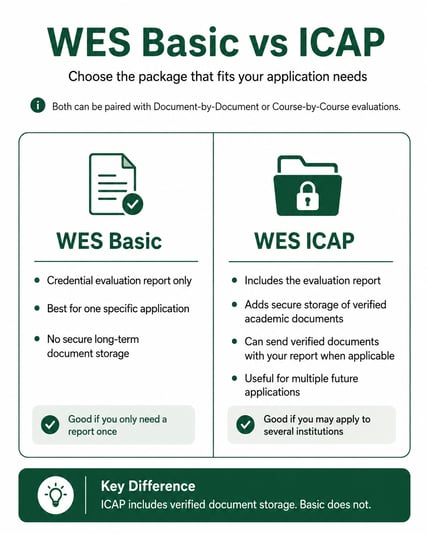
Basic and ICAP are packages, not separate types of academic evaluation. Both can be combined with a Document-by-Document or Course-by-Course evaluation.
WES Basic
The Basic package provides the credential evaluation report. It is generally suitable when you need the evaluation for a particular purpose and do not need WES to permanently store your verified academic documents.
WES ICAP
ICAP stands for International Credential Advantage Package. It includes everything in the Basic package plus secure storage of your verified academic documents. WES can send copies of those verified documents along with your report to recipients when applicable. This can be particularly useful if you expect to use your credentials for multiple applications.
Example: If you only need a WES report for one specific application, Basic may be sufficient. If you expect to apply to several institutions and need verified academic documents sent with your reports, ICAP may be more convenient.
WES Evaluation Fees
WES fees depend on the destination country, evaluation type, package, and additional services. The following are current published starting prices for U.S. evaluations:
|
Evaluation / Package |
Starting price |
|
Document-by-Document – Basic Document-by-Document – ICAP Course-by-Course – Basic Course-by-Course – ICAP |
US$118 US$171 US$186 US$239 |
*NOTE* These prices are for the evaluation itself and do not include delivery or certain additional fees. Beyond the standard processing fees, additional charges may apply if you choose services such as express shipping, expedited processing, or ordering extra copies of your evaluation report.
Since these costs may change from time to time, make sure to check the official website of World Education Services for the most up-to-date fee details before submitting your application.
Validity Period for World Education Services Evaluation
One useful feature of a standard WES credential evaluation is that WES evaluation does not expire. This means that the applicant can retain their evaluation and order additional copies when needed. Once your evaluation report and verified academic records are stored through ICAP, they remain securely saved in the WES system for future use.
However, it is important to remember that some universities in USA and Canada may have their own requirements. In certain cases, institutions may prefer evaluation reports that were issued within the past few years. Also, an individual university, employer, licensing body or immigration authority may have their own rules about how a recent report should be used.
Documents Required for World Education Services Evaluation
The documents required may vary depending on your country of education, institution, qualification, and evaluation type. To ensure a smooth evaluation process, you should carefully follow the document submission guidelines provided by WES. Below are some commonly required documents, they may include:
- Degree or diploma certificate
- Academic transcripts or mark sheets
- Official academic records
- Documents sent directly by the issuing institution through an accepted method
- Certified translations, where required
- Additional documents if requested by WES
WES provides country-specific document requirements, so applicants should not assume that the documents required for one country will be the same for another.
Application Process for World Education Services Evaluation
The WES application process may seem complex at first but the process is neatly structured and can be completed smoothly if you follow each step carefully. The application process is simplifies below and can generally be completed through the following steps:
Step 1: Create a WES Account
Create an account on the WES website and begin your application.
Step 2: Select Your Destination and Purpose
Choose the country where you need the evaluation and indicate whether your purpose is education, employment, licensing, immigration, or another available category.
Step 3: Enter Your Educational Information
Provide information about your institutions, qualifications, programs, and dates of study.
Step 4: Choose Your Evaluation
Select Document-by-Document or Course-by-Course, and then choose Basic or ICAP if that option is available for your purpose.
Step 5: Add Recipients
Enter the universities, employers, licensing organizations, or other institutions that should receive your report.
Step 6: Check Your Document Requirements
Use WES's country-specific instructions to determine exactly which academic documents must be submitted.
Step 7: Pay the Fees
Pay the applicable evaluation and service fees and obtain your WES reference number.
Step 8: Submit Your Academic Documents
Arrange for your educational institution or another authorized source to send the required official documents to WES using an accepted method.
Step 9: Wait for Document Review and Evaluation
WES reviews and verifies the documents. Once the required documents have been accepted, the evaluation process begins.
Step 10: Receive and Send Your Report
After completion, your report can be delivered to you and/or the recipients you selected.
WES Evaluation Takes How Many Days?
Applicants must ensure that they submit their ECA evaluation a maximum of 15-20 days before their actual date of university application submission as the World Education Services Evaluation will arrive within 7-10 days, and the applicants will not have to rush during peak times.
How to Fast-Track Your WES Evaluation Application?
To avoid a delayed WES evaluation process, applicants must:
- Submit all documents at once for WES.
- Do not submit incomplete or incorrect documents.
- Make sure the institution you studied at is recognised or accredited.
- Put the right address and track mail so that documents reach on time (if opted for physical document delivery).
Why choose WES Evaluation?
WES works directly with more than 48,000+ global Higher Education Institutes in 200+ countries and provides life-changing outcomes for their students and alumni. WES evaluates more than 4 million cases annually, making it the largest credential evaluator in North America. WES has a team of 380 experts who come from more than 60 countries and speak over 50 languages. Thus, this empowers WES to communicate directly and understand what they want. WES maintains nearly 30,000 credential samples. This is based on 46 years of their research and data in the database.
A WES evaluation can be an important bridge between international education and new opportunities abroad. With the right evaluation type, accurate documents, and careful planning, the process can be much easier to navigate. Whether your goal is further education, professional growth, or another international opportunity, understanding your credentials is a positive first step toward putting your hard-earned education to work. World Education Services evaluation is an important tool for students and professionals whose educational qualifications were earned internationally. By verifying academic credentials and explaining their equivalency within the U.S. or Canadian education systems, WES helps universities, employers, licensing bodies, and other organizations better understand international education.
Frequently Asked Questions
1. What is a WES evaluation?
A WES evaluation assesses international academic credentials and explains their U.S. or Canadian educational equivalency.
2. What is the difference between WES Basic and ICAP?
Basic provides the evaluation report, while ICAP additionally provides secure storage of verified academic documents, which can make future applications more convenient.
3. How much does a WES evaluation cost?
For U.S. evaluations, current starting prices range from US$118 for Document-by-Document Basic to US$239 for Course-by-Course ICAP (may vary). Additional delivery and service fees may apply.
4. How long does WES take to evaluate credentials?
The timing varies. WES begins the evaluation after the required documents have been received, accepted, and verified, so applicants should allow sufficient time before their deadline.
5. Which WES evaluation should I choose?
It depends on your purpose and the requirements of the organization receiving your report. Document-by-Document is less detailed, while Course-by-Course provides detailed course, credit, grade, and GPA information. Basic and ICAP are package choices that determine how verified documents are handled.