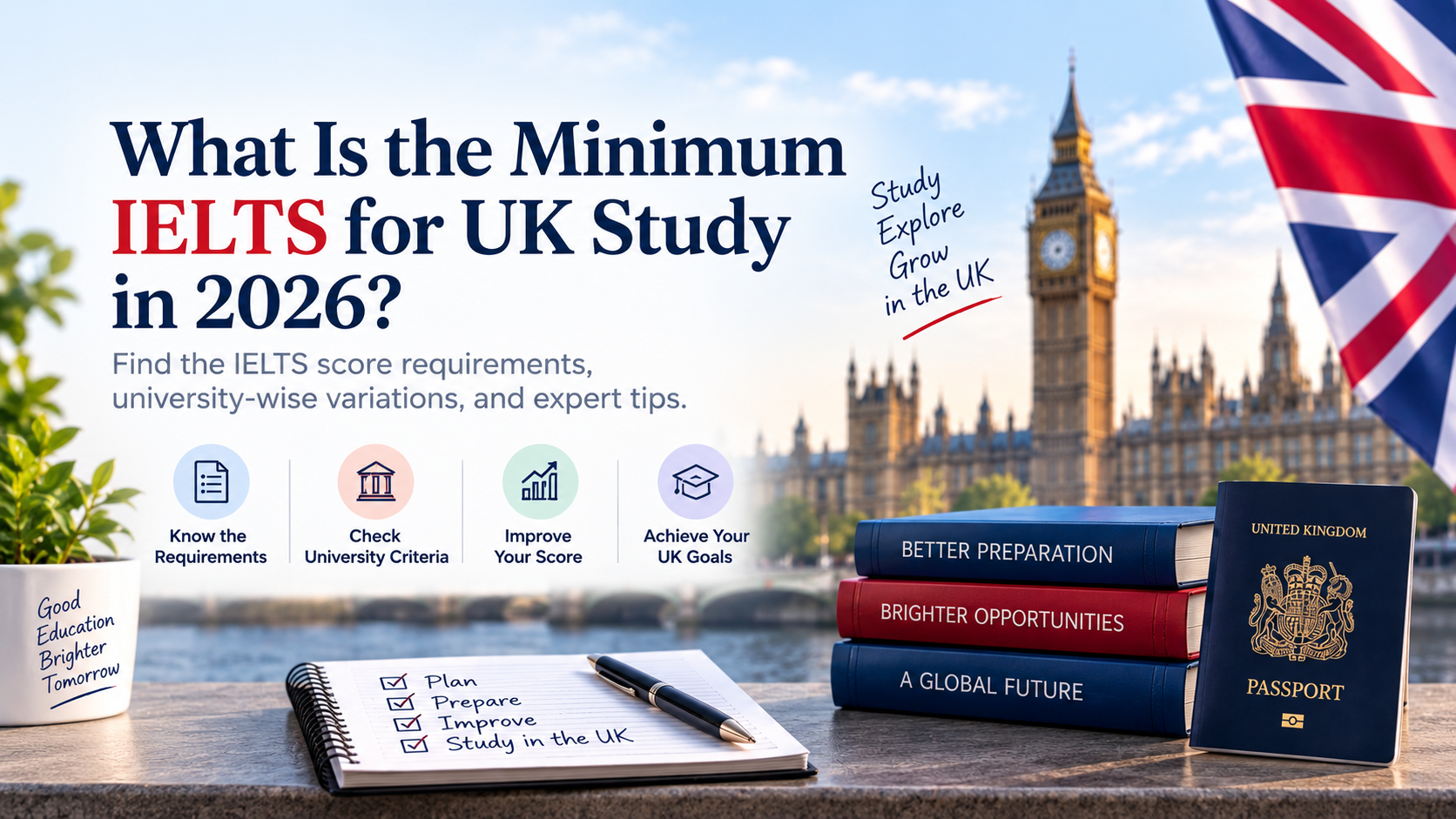
What Is the Minimum IELTS for UK Study in 2026?
 Verified read
There is no single minimum IELTS score for studying in the UK, because two separate systems are actually in play — UK visa rules and individual university admission requirements — and they're not the same thing. The visa system's actual floor is generally lower than most people assume. What usually stops an IELTS 6.0 from being "enough" isn't an immigration rule at all — it's a specific university's own academic policy for a specific course.
The visa-side requirement: lower than most people think
UK universities are designated Higher Education Providers by UKVI, which gives them the authority to assess a degree-level applicant's English proficiency themselves, to a CEFR B2 standard — roughly equivalent to an IELTS score in the 5.5–6.5 range, depending on the specific mapping used. When a university is satisfied at this level, it reflects that on your CAS, and UKVI relies on that confirmation rather than requiring a separate, standalone English test.
This means the actual visa-system floor for direct degree-level study sits meaningfully lower than what many specific courses require. An IELTS 6.0 comfortably clears the CEFR B2 standard that underpins the entire visa system — the reason it might not be "enough" is almost always a university's own academic requirement for a specific course, not an immigration rule.
The one place a formal, separately administered test does apply: courses below degree level — a standalone pre-sessional English course, for instance — require a Secure English Language Test (SELT) from UKVI's approved list, with a considerably lower floor of CEFR B1 (roughly IELTS 4.0). This is a different system from the CAS-based confirmation used for direct degree entry, and it's easy to conflate the two.
The university-side requirement: set by academic policy, not immigration rules
This is the layer most students actually experience, and it varies enormously by course and subject:
- STEM and technical courses commonly sit at or near IELTS 6.0, close to the visa system's own CEFR B2 floor.
- Law, Business, Journalism, English Literature, and many MBA programmes commonly require 6.5–7.5, sometimes with a heavily weighted Writing component — a bar set well above what the visa system itself requires, because the university has decided the course demands stronger English for its own academic reasons.
- The same university can sit at both ends of this range simultaneously, depending on department — Northumbria University, for example, publishes IELTS requirements from 5.5 for some STEM undergraduate courses up to 7.0 for postgraduate Law and Humanities.
Comparing the two systems directly
| Visa system (UKVI) | University admission requirement | |
|---|---|---|
| Who sets it | UK Home Office / UKVI, via CEFR standards | Individual universities, at course/department level |
| Typical floor | CEFR B2 (≈ IELTS 5.5–6.5) for degree-level entry | Varies: 5.5–7.5+ depending on subject |
| How it's confirmed | University's own assessment, reflected on your CAS | Direct test score, MOI certificate, or other accepted evidence |
| When a separate formal test applies | Only for below-degree-level courses (SELT, CEFR B1) | Whenever the specific course requires a direct test score |
What this means practically if your IELTS 6.0 isn't clearing your target course
- Check whether the requirement you're not meeting is course-specific, not universal. The same university may have a different course, or the same subject at a different university, with a lower academic requirement — since the visa system itself would permit it.
- Don't assume a 6.0 is broadly "low." It clears the underlying visa-system standard comfortably; the gap is specifically about your target course's own academic policy.
- If you're specifically applying for a below-degree-level course (a standalone pre-sessional, for instance), check the SELT-specific requirement (CEFR B1) rather than assuming the same rules as direct degree entry apply.
Frequently asked questions
What is the actual minimum IELTS score required by the UK government for a student visa?
There isn't a single fixed test-score minimum, because most direct degree-level students don't take a separate visa-specific test at all — their university self-assesses their English to a CEFR B2 standard and reflects this on their CAS, which UKVI relies on. A formal SELT with a CEFR B1 floor (roughly IELTS 4.0) only applies to courses below degree level.
Why does my target university require IELTS 6.5 if the visa system's floor is lower?
Because the visa system's CEFR B2 standard is a floor, not a ceiling — individual universities are free to set higher requirements for specific courses based on their own academic judgment about what a course demands, independent of what immigration rules require.
Is IELTS 6.0 considered a low score for UK study?
Not by the visa system's own standard — it comfortably clears the CEFR B2 floor that underpins direct degree-level entry. Whether it's "enough" depends entirely on your specific target course's own requirement, which can sit above or at that floor depending on subject and institution.
Do all UK universities require a separate English test for visa purposes?
No. Most direct degree-level applicants don't need a standalone visa-specific test — the university's own English assessment, confirmed on the CAS, satisfies the requirement. A separate SELT only applies to courses below degree level.