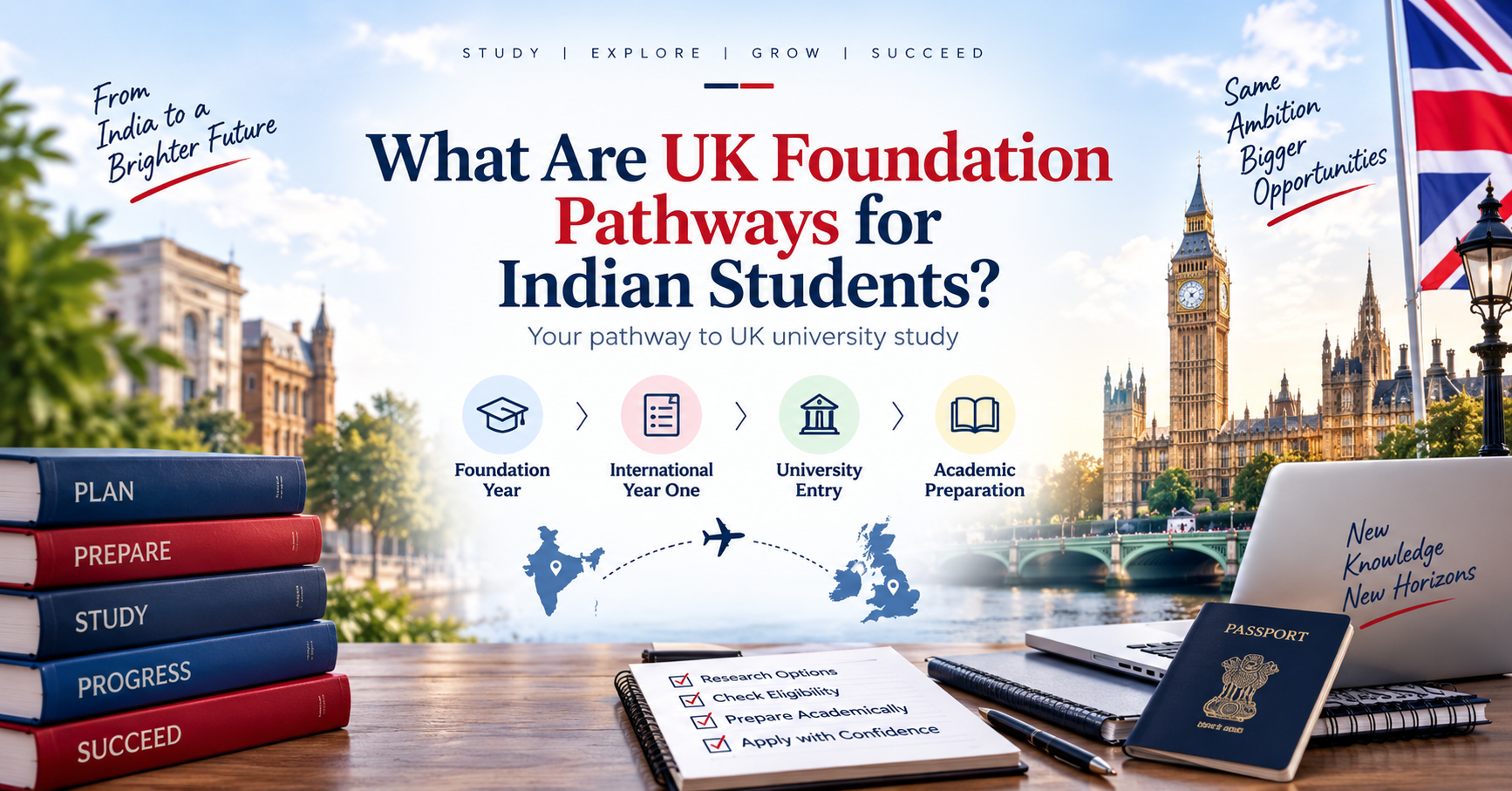
What Are UK Foundation Pathways for Indian Students?
 Verified read
"Foundation pathway" gets used as a catch-all term, but it actually covers several genuinely different routes into UK undergraduate study — each with a different structure, a different type of student it's designed for, and a different level of commitment. If your 12th marks fell short of direct entry requirements, or you've faced a rejection from an Indian university, understanding what each route actually is matters more than picking the first one you come across.
International Foundation Year (IFY / IFP)
What it is: A one-year preparatory programme, taken before Year 1 of a bachelor's degree, covering subject knowledge, academic English, and UK study skills. On successful completion, you progress into the first year of a linked undergraduate course.
Who it's for: International students, including Indian applicants, whose Class 12 results or academic background don't meet a UK university's direct entry requirements, but who are otherwise ready to study at degree level with a year of preparation.
Two structural types:
- University-run foundations, taught directly by the university's own academics from day one — King's College London and Warwick both run well-established versions of this.
- Pathway-provider-run foundations, delivered by specialist providers (INTO, Kaplan, Study Group, Navitas, among others) operating on university campuses under partnership agreements.
The detail that matters most: progression to the linked degree is conditional, not automatic — typically requiring around 80% attendance and module grades in the 50–60% range. It's a genuine route, not a guaranteed one.
International Year One
What it is: A more intensive, faster route that places you directly into the first year of the actual degree after completion, rather than adding a full extra preparatory year before Year 1.
Who it's for: Students whose academic profile is closer to the standard entry bar than a full foundation year assumes — this suits a smaller gap, not a large one.
How it differs from a Foundation Year: A Foundation Year adds a year before your degree starts. International Year One compresses the preparation into a shorter, more intensive format and gets you into Year 1 itself sooner. The right choice between the two depends on how large the gap actually is between your current academic standing and your target course's requirements.
Integrated Foundation Year (within a 4-year degree)
What it is: A foundation year built directly into the structure of the degree itself, applied for as a single 4-year programme through UCAS, rather than as a separate qualification followed by a separate degree application.
Who it's for: Students who want the foundation route but prefer the administrative simplicity of one application and one visa covering the entire period, rather than reapplying and potentially needing a fresh visa after the foundation year.
Access to Higher Education (Access to HE) Diploma
What it is: A UK qualification designed to prepare students without traditional school-leaving qualifications (like A-levels) for degree-level study, typically delivered over one year at a UK further education college.
Who it's actually for: This is worth being precise about, because it's often mentioned in generic "alternative routes" lists without the context that matters — Access to HE Diplomas are primarily designed for UK-resident adult learners (commonly 19 or older) returning to education, not for international students applying directly from a school system like India's. If you're applying from India with a completed or near-completed Class 12 qualification, an International Foundation Year or International Year One is almost always the more relevant route, not an Access to HE Diploma. It's included here mainly so you can recognise it and rule it out correctly, rather than spend time investigating a route that isn't actually designed for your situation.
HND-to-Top-Up Bachelor's route
What it is: A Higher National Diploma (a vocationally-oriented qualification) followed by a shorter "top-up" bachelor's degree that converts the HND into a full honours degree, often completed in one additional year.
Who it's for: Students with a vocational or diploma-based academic background, or those who specifically want a more applied, industry-oriented route rather than a traditional academic foundation year.
How these routes actually compare
| Route | Adds time before degree starts? | Best suited to |
|---|---|---|
| International Foundation Year | Yes — one year | A meaningful gap below direct entry requirements |
| International Year One | No — enters Year 1 after a faster preparation period | A smaller gap, closer to the standard bar |
| Integrated Foundation Year | Yes — but structured as one 4-year UCAS application | Students who want foundation-route flexibility with simpler admin |
| Access to HE Diploma | Yes — one year | UK-resident adult learners, generally not international school-leavers |
| HND-to-Top-Up | Yes — typically two years to a full degree | Vocational or diploma-based academic backgrounds |
Choosing between them
The right route depends on the size of the gap between your current academic profile and your target course's requirements, and on how your prior qualification is structured:
- A meaningful gap, standard academic background: International Foundation Year
- A smaller gap, standard academic background: International Year One
- Want the simplicity of one combined application and visa: Integrated Foundation Year
- Vocational or diploma-based prior qualification: HND-to-Top-Up route
- UK-resident, returning to education as an adult learner: Access to HE Diploma (not typically relevant for direct applicants from India)
Frequently asked questions
What's the difference between a Foundation Year and International Year One?
A Foundation Year adds a full preparatory year before Year 1 of the degree. International Year One is a faster, more intensive route that places you directly into Year 1 after a shorter preparation period, suited to a smaller gap between your current grades and the standard entry requirement.
Is an Access to HE Diploma a good option for Indian students applying directly from school?
Generally no. Access to HE Diplomas are designed primarily for UK-resident adult learners returning to education, not for international students applying with a recent Class 12 qualification. An International Foundation Year or International Year One is almost always the more relevant route for this situation.
Does completing a foundation pathway guarantee entry to the linked degree?
No — it guarantees a conditional offer, dependent on meeting specific progression requirements (commonly around 80% attendance and 50–60% module grades). Always confirm your programme's specific progression criteria before enrolling.
Which foundation route is cheaper — university-run or pathway-provider-run?
This varies, but pathway-provider-run foundations (through providers like INTO, Kaplan, or Study Group) are sometimes positioned at a broader, occasionally lower cost range than some university-run foundations, though this isn't a fixed rule — compare specific programmes directly rather than assuming one type is always cheaper.