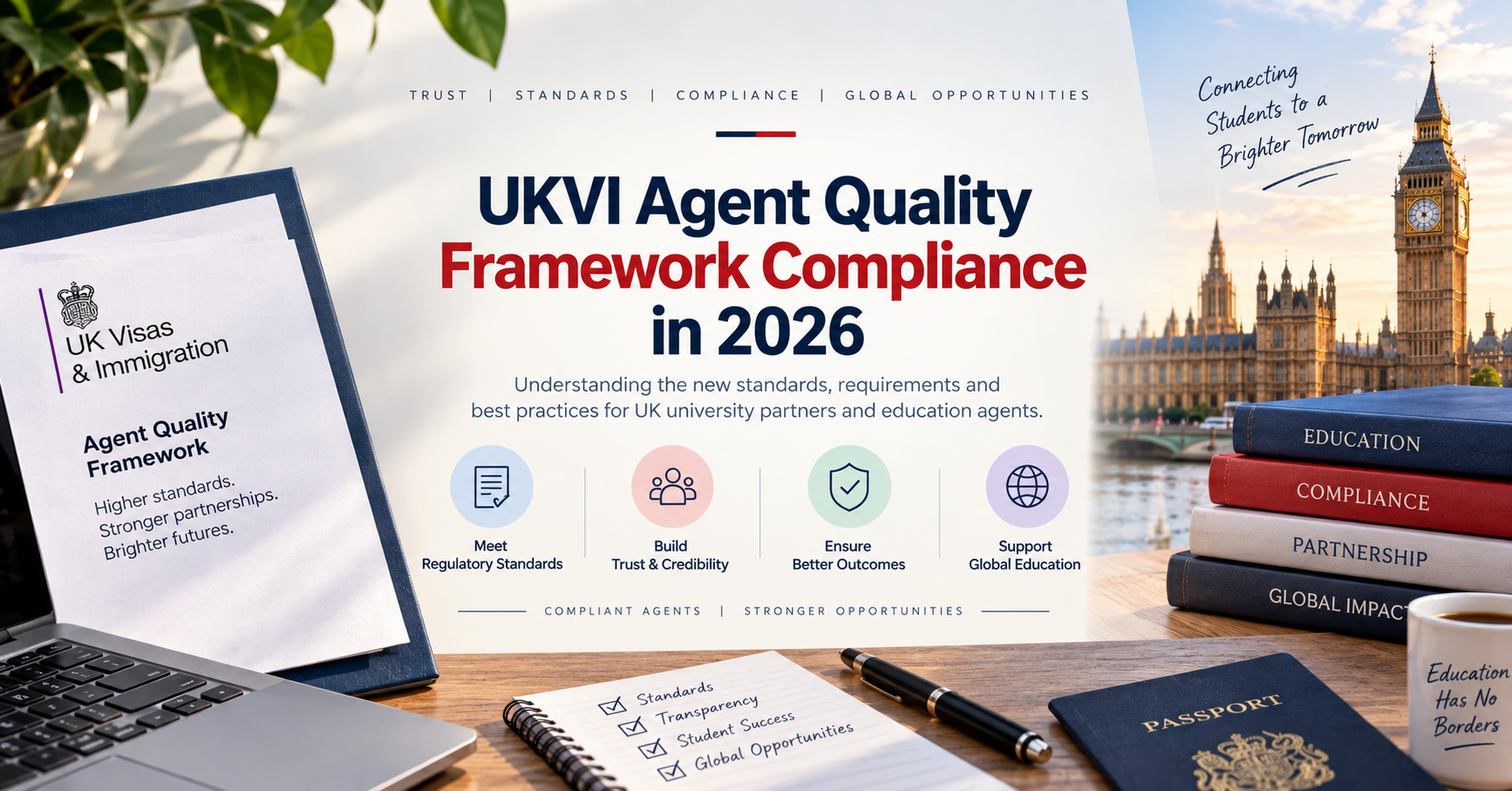
UKVI Agent Quality Framework Compliance in 2026
 Verified read
Holding an Agent Quality Framework badge is not the same as being able to evidence compliance when a partner university asks for proof. Since April 2026, Home Office Student Sponsor Guidance directly references the AQF for institutions using recruitment agents — meaning universities are increasingly expected to verify, not just trust, that their agents meet the framework's standards. This is what independent agents should actually have on record, item by item.
Core accreditation evidence
- A current, dated record of National Code of Ethical Practice sign-up — not just the initial registration, but confirmation it remains active and hasn't lapsed.
- UK Knowledge training completion certificate, with the specific completion date, for every individual counsellor operating under your agency, not just a company-wide statement.
- Current AQF digital badge status for each counsellor, retrievable on request rather than requiring a separate lookup each time a partner university asks.
- A record of when each credential was last renewed or reviewed, since a credential completed years ago with no evidence of ongoing engagement is a weaker position than a recently confirmed one.
Commission and transparency evidence
- A documented, standard disclosure statement confirming that students are told plainly about the commission relationship with the institutions you recommend — kept as a record you can show was actually communicated, not just a policy that exists on paper.
- Clarity in your own records on whether commission varies by institution, and whether that variation is disclosed to students where relevant.
- Documentation of the fee basis used in your commission agreements (net versus gross), since this is a detail national and institutional auditors increasingly ask about directly.
Application consistency and quality evidence
- A documented internal process describing what your agency checks before submitting an application — specifically, whether the SOP, financial evidence, and academic history are cross-checked for consistency, not just completeness.
- Records showing this consistency check was actually performed per application, not just a described policy that isn't evidenced case by case.
- A documented process for how study gaps are handled in applications you submit — whether supporting documentation is gathered and reviewed before submission.
Sub-agent and referral chain evidence
- A clear record of whether your agency uses sub-agents, and if so, their own accreditation status under the National Code and AQF.
- Documentation of what oversight your agency applies to sub-agent conduct, since this is an area increasingly scrutinised as a potential compliance gap.
- A defined escalation and complaints process for issues arising from sub-agent-handled applications, not just your own direct cases.
The immigration advice boundary — evidence of staying within it
- A written internal policy distinguishing what your counsellors are authorised to do (course guidance, application support, general process information) from activities that would require Immigration Advice Authority (IAA) registration (advising on individual visa eligibility, refusal strategy, legal representations).
- Records of any referrals made to IAA-registered advisers or solicitors where a case moved beyond general education agent guidance into individual immigration advice.
- Periodic internal review confirming counsellor practice actually stays within this boundary, not just a policy document that exists without active application.
Refusal-rate and outcome tracking
- Your own internal tracking of visa outcomes by destination institution and by counsellor, since partner universities are increasingly likely to ask about this directly, given how agent-linked refusals affect their own RAG compliance position.
- A documented process for reviewing and responding to any pattern of refusals linked to a specific counsellor or referral source, before a partner university raises it as a concern.
Why evidence, not just accreditation, is what actually protects your agency
An AQF badge demonstrates that a standard was met at a point in time. What increasingly matters to partner universities — particularly since the April 2026 guidance update — is whether you can produce evidence that these standards are actively maintained and applied, not just held. An agency that can retrieve every item above promptly, per counsellor, is in a fundamentally stronger position during a partner university's own compliance review than one relying on a badge and a general assurance of good practice.
Frequently asked questions
Is an AQF badge sufficient evidence of compliance for a partner university?
Increasingly, no — universities are expected to verify AQF commitment specifically, and a badge alone doesn't demonstrate ongoing evidence of active compliance, consistency checking, or proper handling of the immigration advice boundary. Maintaining retrievable, per-counsellor evidence is a stronger position.
What should an agency track regarding sub-agents specifically?
Whether sub-agents are used at all, their own accreditation status under the National Code and AQF, what oversight is applied to their conduct, and a defined complaints and escalation process for issues arising from sub-agent-handled cases.
Why does refusal-rate tracking matter for an independent agent's own compliance position?
Because refusals linked to a specific agent's applications count against the sponsoring university's own visa refusal metric under the RAG system — meaning a pattern in your own outcomes is something partner universities are increasingly likely to ask about directly, and being able to show you track and respond to this proactively is a real compliance advantage.
What's the difference between AQF compliance and staying within the immigration advice boundary?
AQF governs the quality, ethics, and transparency of your conduct as an education agent. The immigration advice boundary is a separate legal question, governed by the Immigration Advice Authority, about whether specific advice you're giving requires separate regulatory authorisation. Meeting AQF standards doesn't authorise giving immigration advice, and the two should be tracked as distinct compliance areas.