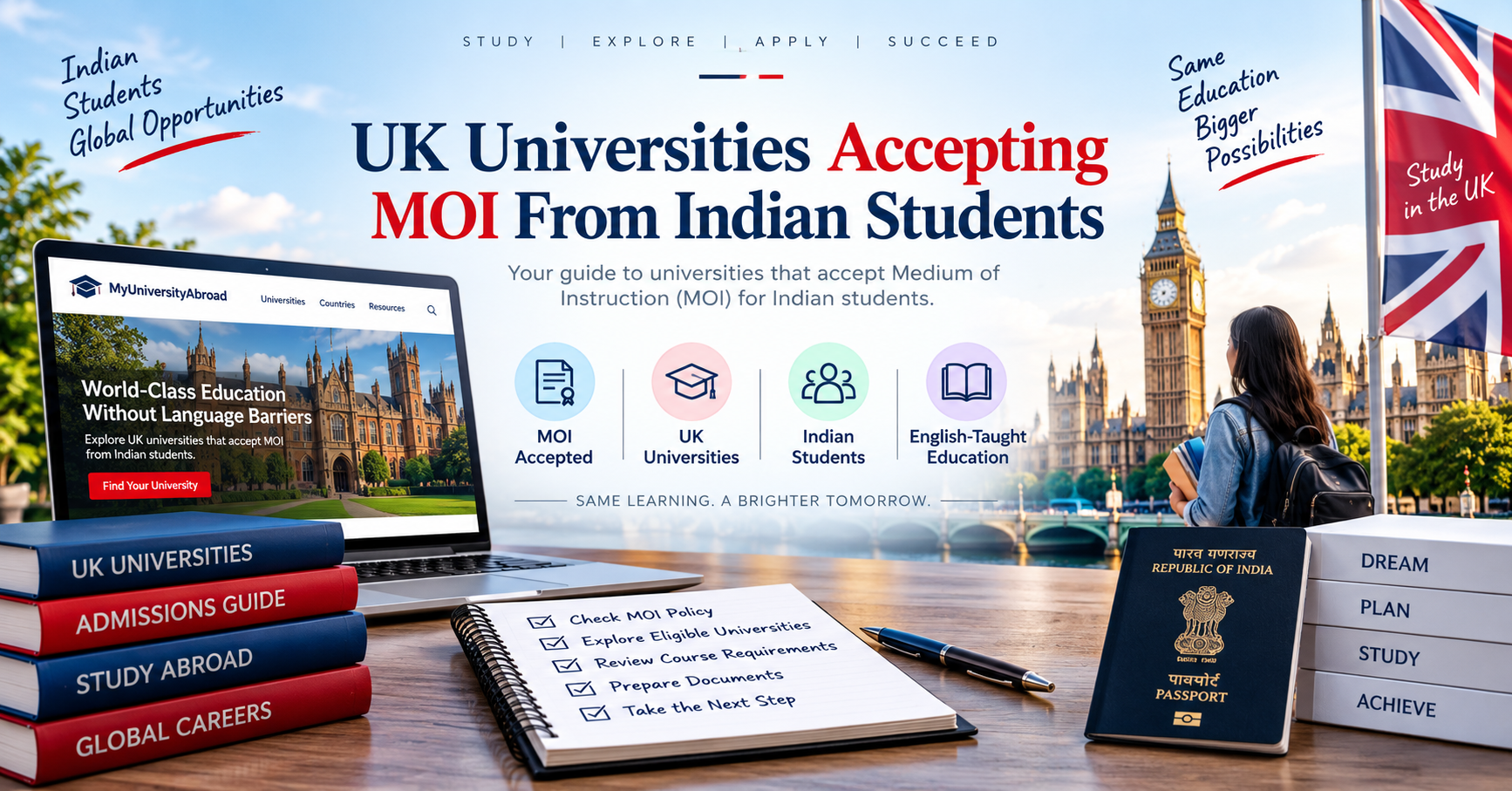
UK Universities Accepting MOI From Indian Students
 Verified read
A Medium of Instruction (MOI) certificate lets many UK universities waive IELTS for applicants whose previous degree was taught entirely in English — a route commonly used by Indian students from CBSE, ICSE, and English-medium university backgrounds. It isn't a universal substitute: acceptance varies by university and course, the certificate must meet specific content requirements to be valid, and it needs to be verified directly with your target institution before you rely on it. Here's what actually goes into a valid MOI certificate, why they get rejected, and how to check your eligibility before applying.
What an MOI certificate actually is
An MOI certificate is an official document issued by the institution where you completed your previous degree, confirming that your course was taught and assessed entirely in English. It's issued by your university's registrar (or equivalent office), not by any external testing body — which is exactly why its acceptance depends entirely on your target UK university's own policy, not a fixed national standard.
Important context: the UK government does not formally recognise the MOI certificate as a defined visa document type. It works because UK universities are UKVI-designated Higher Education Providers with the authority to assess an applicant's English proficiency themselves — an MOI certificate is one form of evidence they can use to satisfy themselves of that, which they then reflect in their own confirmation on your CAS. UKVI relies on the university's assessment, not the MOI certificate directly.
What must be on a valid MOI certificate
There's no single fixed format — every institution issues its own — but a certificate that will actually be accepted needs to include:
- Official letterhead with the institution's name, logo, and contact details
- Your full name, matching exactly what appears on your passport
- The name and level of your degree (for example, "BSc Computer Science")
- The period of study (start and end dates)
- An explicit statement that English was the medium of instruction and assessment for the entire programme — not a partial or ambiguous statement
- The date your degree was awarded, and specific wording confirming it was "awarded," "granted," or "conferred"
- Signature, name, and designation of an authorised official (typically the registrar)
- An official stamp or seal
- Contact details for verification, since UKVI or the university may check the certificate's authenticity directly with the issuing institution
Why MOI certificates commonly get rejected
Most rejections come down to a small, predictable set of issues:
- Missing the date of award. This is one of the most commonly documented rejection reasons — a certificate confirming the medium of instruction without stating when the degree was actually conferred is frequently treated as incomplete.
- Vague or partial language coverage. A statement that doesn't clearly confirm English was used for the entire programme — rather than just some courses — undermines the certificate's purpose.
- Issued on plain paper rather than official letterhead, even with a stamp and signature attached.
- Certificate issued for the wrong qualification level. An MOI certificate for your Class 12 schooling doesn't substitute for one covering your bachelor's degree if you're applying for a Master's — it needs to match the qualification your application is actually built on.
- Age of the degree. Several universities apply a recency expectation, commonly around five years, though this varies — an MOI for an older degree may need to be paired with a more recent English proficiency letter or additional evidence.
- Missing enrolment or registration number, where a university specifically requires it for verification purposes.
How to verify your eligibility before applying
Rather than assuming MOI acceptance based on a general list, verify it directly through this sequence:
- Check your target course's specific entry requirements page, not the university's general international admissions page — English proficiency policy, including MOI acceptance, is often set at course or department level and can differ even within the same university.
- Email admissions directly with your specific degree details — your institution, course, graduation year, and grading — and ask for written confirmation that an MOI certificate will be accepted in place of IELTS for your specific course. Keep this confirmation on file.
- Request your MOI certificate early. Processing typically takes one to three weeks, and delays here can affect your application timeline if you're working toward a deadline.
- Check the certificate against the full content checklist above before submitting it, ideally before your university even asks — catching a missing date of award or vague wording yourself is far better than discovering it during application review.
- Ask specifically whether the MOI-based waiver will be reflected on your CAS. This is the detail that actually matters for your visa, since UKVI relies on the university's own confirmation, not the MOI certificate as a standalone document.
Frequently asked questions
Do all UK universities accept MOI certificates instead of IELTS? No. Acceptance varies by university and often by specific course or department. A number of UK universities do accept MOI certificates, but there's no universal policy — always confirm directly with your target course rather than relying on a general list.
Does the UK government officially recognise MOI certificates for visa purposes? Not as a defined visa document type. UK universities have the authority, as UKVI-designated Higher Education Providers, to assess English proficiency themselves, and an MOI certificate is one form of evidence they can use for that assessment — the visa relies on the university's resulting confirmation on your CAS, not the MOI certificate directly.
Why do MOI certificates get rejected most often? The most common reasons are a missing date of award, vague wording that doesn't clearly confirm English was used for the entire programme, issuance on plain paper rather than official letterhead, or the certificate covering the wrong qualification level for the application.
How old can my degree be for an MOI certificate to still be accepted? This varies by university, but a commonly cited expectation is that the underlying degree should be within roughly five years. Older degrees may still be accepted, sometimes alongside additional supporting evidence — confirm directly with your target university.
Can I use an MOI certificate for my visa if my university accepted it for admission? Generally yes, since UKVI relies on your university's own CAS-based confirmation of your English proficiency rather than requiring a separate test. Confirm this explicitly with your university, since the exact mechanism can vary.