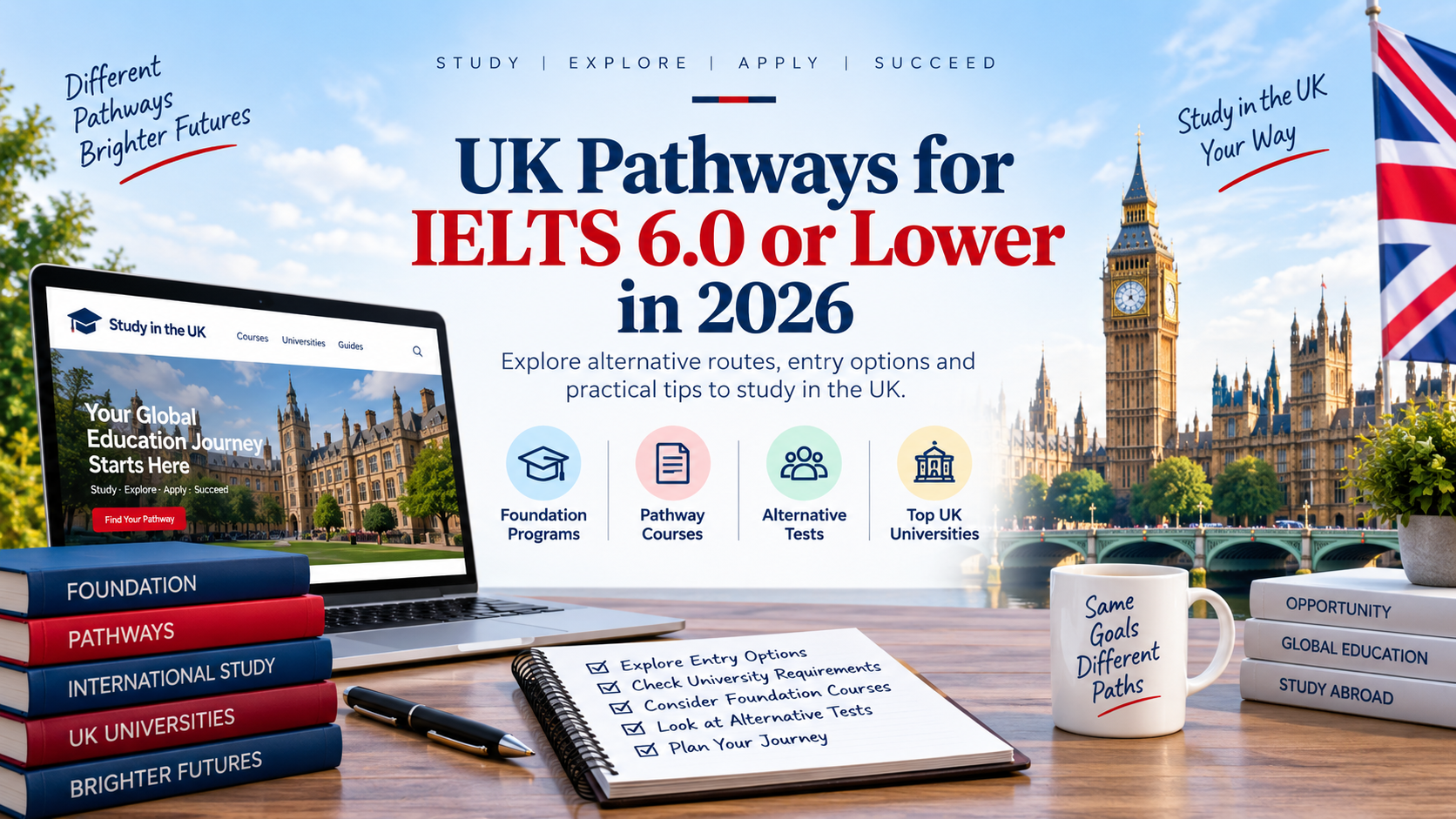
UK Pathways for IELTS 6.0 or Lower in 2026
 Verified read
An IELTS 6.0 doesn't just open direct entry to some UK courses — it's also often enough to enter a foundation year for courses that would otherwise require a higher direct-entry score. This is the detail most IELTS guides miss: foundation programmes typically carry a lower English requirement than the degree they lead into, which means a 6.0 that falls short of your target course's direct-entry bar can still get you there through a different door.
What IELTS 6.0 gets you directly, and where it falls short
For many undergraduate courses and a meaningful share of postgraduate courses, particularly in STEM subjects, IELTS 6.0 clears direct entry outright. Where it typically doesn't: Law, Business, Journalism, English Literature, and many MBA programmes, which commonly require 6.5 or higher — sometimes considerably higher, with a Writing component weighted heavily.
If your target course sits in this second group, the useful next question isn't "how do I get a higher IELTS score" — it's "does this university's foundation year for this subject accept 6.0, even though the degree itself requires more."
Why foundation programmes accept lower scores than the degree they lead to
Foundation years exist specifically to bring a student up to the standard the direct degree requires — academically and linguistically. Because of this, their English entry requirement is typically set below the degree's own requirement, not matched to it. A university might require IELTS 6.5 for direct entry to a Business degree, while accepting 6.0 — or in some cases lower — for the foundation year that leads into the same degree.
This means an IELTS 6.0 that looks like a rejection for direct entry can be exactly the score you need for a foundation-year place at the same institution, in the same subject area, without needing to retake the test or take a separate pre-sessional course first.
What to check for your specific case:
- Your target course's direct-entry IELTS requirement (often 6.5+ for Business, Law, Humanities)
- The foundation year's IELTS requirement for the same subject area at the same university (frequently 5.5–6.0)
- Whether the foundation year explicitly guarantees progression to the specific degree you want, and under what academic conditions
When a pre-sessional course is the better route instead
If your score is below even the foundation year's entry requirement — commonly below 5.5 — a pre-sessional English course is the more appropriate bridge, rather than trying to enter a foundation year your score doesn't yet support.
- Entry threshold: UKVI's own minimum for pre-sessional courses sits at CEFR B1 (roughly IELTS 4.0), a genuinely lower bar than foundation-year entry
- Duration: typically 6–20 weeks, scaled to the size of the gap between your current score and your target
- What it leads to: successful completion typically lets you progress into either direct degree entry or a foundation year, depending on how large the original gap was
Putting the three options together
| Your situation | Best-fit pathway |
|---|---|
| IELTS 6.0, target course requires 6.0 | Direct entry — no pathway needed |
| IELTS 6.0, target course requires 6.5+ | Foundation year for the same subject, often accepting 6.0 or lower |
| IELTS below 5.5, target foundation year requires 5.5–6.0 | Pre-sessional English course first, then foundation year or direct entry |
| IELTS below 4.0 | Pre-sessional course is the starting point, since this sits below most foundation-year thresholds too |
Why this matters for cost and timeline planning
Skipping a pre-sessional course you don't actually need saves both time and money — pre-sessional courses add £2,000–£4,500 and 6–20 weeks on top of your main programme. If your score already clears the foundation year's requirement, going straight into the foundation year (rather than a pre-sessional course first) is usually the more efficient path, provided your target university's foundation programme accepts your current score.
Frequently asked questions
Can IELTS 6.0 get me into a foundation year even if it's below the direct-entry requirement for my target degree?
Often yes. Foundation year English requirements are typically set lower than the degree's own direct-entry requirement, commonly in the 5.5–6.0 range, specifically because the foundation year is designed to help close that gap. Always confirm the specific requirement for your subject area at your target university.
Do I need a pre-sessional English course if my IELTS is already 6.0?
Not necessarily. If your score meets your target foundation year's entry requirement, you can typically go straight into the foundation year without a separate pre-sessional course. A pre-sessional course is more relevant if your score falls below the foundation year's own threshold, commonly under 5.5.
What's the minimum IELTS score needed for a UK pre-sessional English course?
UKVI's baseline is CEFR B1, roughly equivalent to IELTS 4.0, though most pre-sessional courses are designed for students starting somewhat above this floor, with course length adjusted to the size of the gap.
Does using a foundation year pathway cost more than direct entry?
Yes, since it adds a year of additional tuition and living costs before your actual degree begins. Where it can still be more efficient than the alternative is when it lets you skip an unnecessary pre-sessional course, since your existing score already clears the foundation year's own entry bar.