 Verified read
Imagine receiving two university acceptance letters. One takes you to Canada, with its vast network of universities, multicultural cities and extensive research ecosystem. The other takes you to New Zealand, where globally recognised institutions meet a smaller, more intimate education environment and an exceptional quality of life.
Both sound like dream destinations. But in 2026, choosing between them is no longer simply about asking, “Which country has better universities?”
The more important questions are: Which country fits your budget? Which offers the right academic environment? Where are your post-study opportunities stronger? How predictable is the student-visa process? And which destination makes more sense for your long-term career plans?
Canada and New Zealand remain attractive destinations for international students, but their immigration and education policies have evolved significantly. Canada has tightened its international student system, while New Zealand has expanded some work and post-study options.
So, if you are planning to study abroad in 2026, which should you choose?
Let's compare them across the factors that actually matter.
New Zealand vs Canada: At a Glance
|
Factors |
New Zealand |
Canada |
|
Country Ranking for Education |
27 |
19 |
|
Safety Index |
90 |
88 |
|
Total Universities/Institutions |
8 |
101 |
|
Popular Programs |
|
|
|
Language of Instruction |
English |
English |
|
Average Tuition Fees |
NZD 22,000 – 45,000/year |
CAD 12,000 – 42,000/year |
|
Average Annual Cost of Living |
NZD 20,000/year |
CAD 22,895/year High (Toronto/Vancouver) / Moderate (elsewhere) |
|
Student Visa Cost |
NZD 850 |
CAD 235 |
|
Global ranking |
Top 80–200 |
Top 25–50 |
|
Post-Study Work Visa Duration |
Up to 3 years |
Up to 3 years |
|
Climate |
Mild temperate climate with warm summers and cool winters. No extreme temperatures. |
Cold continental climate with very cold winters and mild to warm summers. |
New Zealand vs Canada: Quality of Education
For 2026 applicants, Canada and New Zealand both offer strong education systems, but they approach international education differently. Canada provides a considerably larger higher-education ecosystem, with universities, colleges and specialised institutions spread across provinces and territories. New Zealand's system is smaller but offers internationally recognised universities and a comparatively compact education environment.
The best destination therefore depends less on popularity and more on fit.
New Zealand
New Zealand has eight universities, alongside institutes, polytechnics and private training establishments. Its universities offer programmes across fields such as: engineering, business and management, computer science and IT, environmental science, agriculture, health sciences, education, arts and humanities, law, architecture
New Zealand promotes a flexible higher-education system with different types of providers and programmes. Its official education platform highlights quality education, career readiness and student experience as major advantages.
One of New Zealand's attractions is the opportunity to study in a relatively compact academic environment. Students may find it easier to develop closer academic relationships and experience a less sprawling university system.
Canada
Canada's biggest academic advantage is scale. Students can choose from a large number of universities, colleges and specialised institutions, with programmes ranging from undergraduate degrees to research-intensive master's and doctoral programmes.
Canada is particularly attractive for students interested in: artificial intelligence, computer science, engineering, business, data science, biotechnology, healthcare, environmental sciences, finance and research.
If your priority is programme variety, institutional choice and a large research ecosystem, Canada has the advantage.
If you prefer a smaller and more focused education environment, New Zealand can be an excellent alternative.
Tuition Fees: Which Is More Affordable?
Cost is one of the most important considerations for international students. However, there is no single tuition figure for either country because fees vary according to the university, programme, qualification and location.
Canada
According to official data for 2026, the average tuition for international undergraduate students is approximately CAD 41,746 per year, while international graduate students average approximately CAD 24,028 per year. Professional and specialised programmes can cost considerably more.
For students considering Canada, the smart approach is therefore to calculate: Tuition + accommodation + food + transport + insurance + study materials + visa expenses, rather than looking at the tuition alone.
New Zealand
New Zealand also has significant variation in international tuition depending on the provider and course. Students should check the individual university's current fee schedule rather than relying on generic averages. The official Study with New Zealand platform specifically encourages students to research programme costs and available scholarships before making a decision.
Cost of Living: New Zealand vs Canada
Tuition is only half the financial equation. The cost of accommodation, groceries, transport and everyday life can substantially affect your study-abroad budget.
New Zealand
New Zealand's official student information platform provides examples of accommodation costs ranging from shared housing to catered halls of residence. It also recommends students create a realistic budget for everyday expenses. Immigration New Zealand currently requires tertiary students to demonstrate funds for living costs of NZD 20,000 per year, or NZD 1,667 per month for shorter periods of study. This is a visa financial requirement, not necessarily a prediction of what every student will spend.
Canada
Canada also requires international students to demonstrate sufficient financial resources. The Canadian government states that students must demonstrate they can cover tuition, living expenses and transportation without relying on work in Canada to meet the financial requirement.
As of September 2025, the financial requirement for a single student was CAD 22,895 for living expenses, excluding tuition and transportation, with the amount adjusted periodically.
Health Insurance and Healthcare Access: A Cost Most Students Underestimate
Tuition and rent tend to dominate the budgeting conversation, but health insurance is a mandatory, non-negotiable cost in both countries, and the two systems work in almost opposite ways.
In New Zealand, international students are not eligible for publicly funded healthcare and must carry private insurance for the full duration of their student visa, as required under the Education (Pastoral Care of Tertiary and International Learners) Code of Practice 2021. University-approved policies such as Studentsafe typically run NZD 600–900 per year, though rates as low as NZD 350 and as high as roughly NZD 900 appear across different approved providers. Without coverage, costs escalate quickly: a single night in hospital as a non-resident can exceed NZD 1,000. One useful offset is New Zealand's Accident Compensation Corporation (ACC) scheme, a no-fault, government-funded system that automatically covers every person in the country, including international students, for accident-related injuries such as broken bones or sports injuries, at no direct cost and with no separate enrolment required. Illness and routine GP visits, however, still fall to private insurance.
Canada's system is a genuine patchwork that varies by province, which makes it easy for students to assume incorrectly that healthcare is simply "free" everywhere in the country. Alberta, Saskatchewan, New Brunswick, Newfoundland and Labrador, and Prince Edward Island extend public provincial health coverage to eligible international students at no cost, though PEI applies a three-month waiting period. Ontario, Manitoba, British Columbia, and Quebec (for students outside the 11 countries with bilateral healthcare agreements) require mandatory paid coverage instead: Ontario's UHIP runs around CAD 66 per month, British Columbia's MSP costs roughly CAD 75 per month with a three-month waiting period during which private interim insurance is required, and Manitoba's MISHP costs approximately CAD 1,200 per year. On top of provincial or university-mandated basic coverage, many student unions also negotiate a supplementary extended health plan, typically CAD 250–500 per year, covering dental, vision, prescriptions and mental health counselling that base plans usually exclude.
Part-Time Work While Studying
Part-time employment can help students gain experience and manage some everyday expenses—but it should not be the foundation of your financial plan.
New Zealand
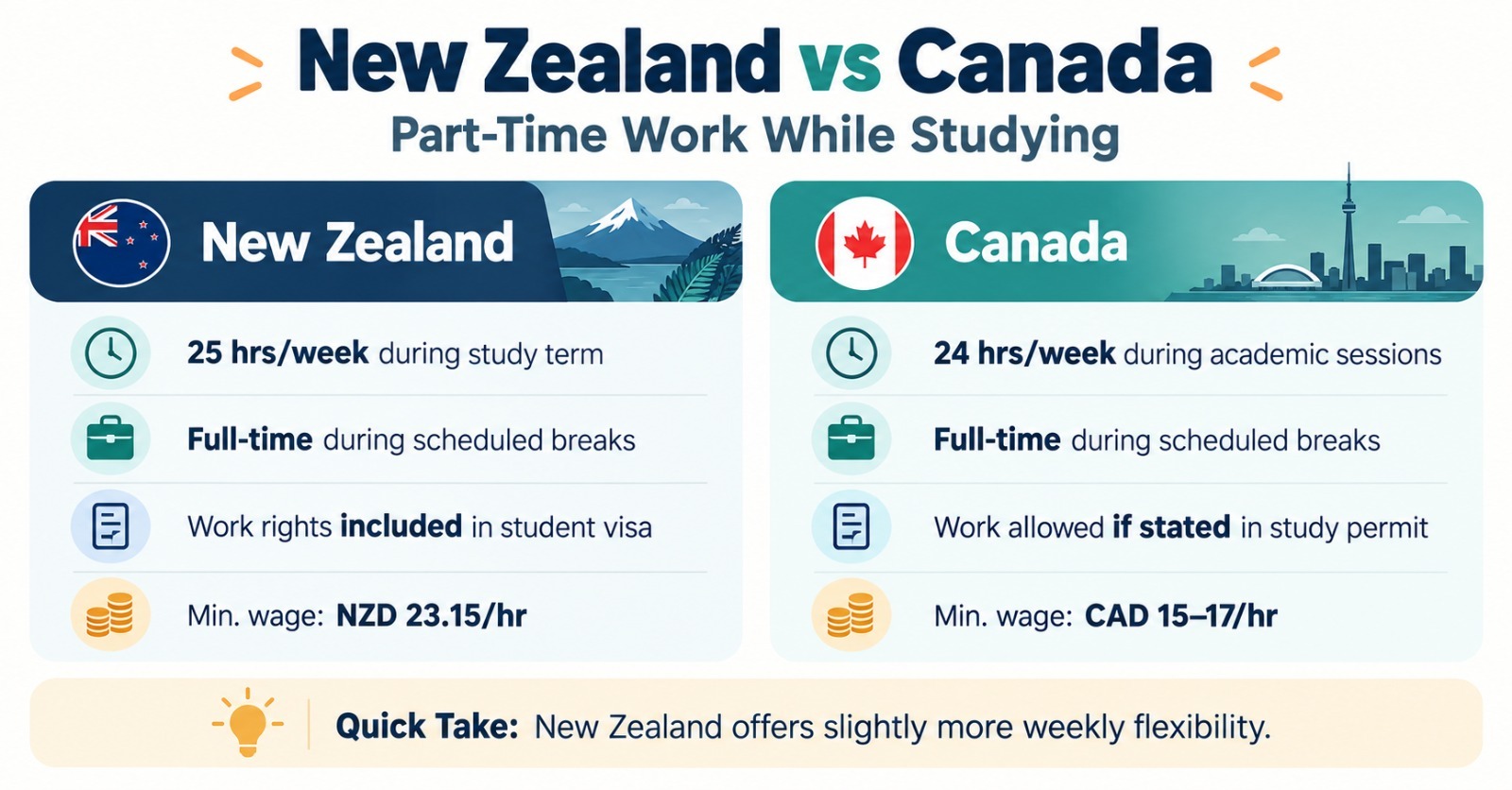
Eligible students can generally work up to 25 hours per week during the academic term, depending on the conditions attached to their student visa. Some students can also work full-time during scheduled breaks.
The permitted hours increased from 20 to 25 hours per week in November 2025.
Canada
Eligible international students can generally work up to 24 hours per week off campus during regular academic sessions, with different rules applying during scheduled breaks.
On the standard weekly limit, New Zealand currently provides slightly more flexibility: 25 hours versus Canada's 24 hours for eligible students. But work rights should never be the sole reason for choosing a country.
|
Part-Time Work Aspects |
New Zealand |
Canada |
|
Work Hour Limits |
25 hours/week during study term Full-time during scheduled breaks |
24 hours/week during academic sessions Full-time during scheduled breaks |
|
Eligibility |
Must be enrolled full-time in an eligible course (typically Level 4+ or approved programs) |
Must be enrolled full-time at a Designated Learning Institution (DLI) and in a program leading to a degree, diploma, or certificate |
|
Permit Required |
No separate permit: work rights are included in student visa conditions |
No separate work permit: work allowed if stated in the study permit |
|
Types of Work Allowed |
Mostly part-time/casual jobs (retail, hospitality, services); limited structured industry roles |
On-campus + off-campus jobs, plus co-op/internships (co-op permit required if mandatory in program) |
|
Minimum Wage |
NZD 23.15/hour (national minimum wage) |
Varies by province; generally, CAD 15–17/hour |
|
Average Hourly Rate |
Typically, NZD 23–28/hour |
Typically, CAD 15–22/hour |
Post-Study Work Opportunities
This is where the comparison becomes particularly important. Unlike other countries, where applying for a post-study work permit requires a job in hand, in both Canada and New Zealand, there is no such rule.
New Zealand Post-Study Work Visa
New Zealand's Post Study Work Visa can allow eligible graduates to remain in the country and work for up to three years, depending on what they studied. New Zealand is also changing its post-study framework in 2026.
From 16 November 2026, eligibility is being extended to certain graduates who complete an eligible Level 7 Graduate Diploma while holding a bachelor's degree. A new Short-term Graduate Work Visa will also provide eligible graduates with up to six months of open work rights. This makes it especially important for students beginning programmes around this period to check the rules applicable to their exact qualification.
Canada's Post-Graduation Work Permit
Canada's PGWP remains one of its major attractions, but eligibility is no longer something students should assume automatically. Students must meet specific eligibility requirements and graduate from an eligible programme at a designated learning institution. Depending on the programme, language and field-of-study requirements may apply.
There is, however, an important advantage for degree students: Canada's current rules do not impose a field-of-study requirement on graduates of bachelor's, master's or doctoral degrees. For eligible master's programmes, students can potentially receive a three-year PGWP even when the master's programme itself is less than two years, provided other conditions are satisfied and the programme meets the required duration threshold.
Since there is no 'Job Search Visa' in Canada, and the closest equivalent in New Zealand is the new Short-Term Graduate Visa (6 months), it is crucial to understand the timing of applying for a work permit.
- In New Zealand, you must apply within 3 months of your student visa expiring.
- In Canada, while you have 180 days to apply, you must submit your application the moment you receive your final confirmation of graduation to maintain your legal right to work.
Student Visa Environment in 2026
This is one area where the two destinations have changed significantly.
Canada's New Reality
Canada has introduced stronger controls over international student numbers following rapid growth in the sector. The federal government introduced an international student study-permit cap and has announced further reductions for 2025 and 2026. Most applicants also need a provincial or territorial attestation letter.
However, there is an important 2026 exception. From January 1, 2026, students entering degree-granting master's or doctoral programmes at public designated learning institutions generally do not need a PAL/TAL. Quebec has separate requirements.
This makes Canada particularly interesting for international students pursuing postgraduate education.
New Zealand
New Zealand's student visa process requires an offer of place from an approved education provider and evidence that the applicant meets relevant health, character and financial requirements.
The Fee Paying Student Visa currently starts at NZD 850, according to Immigration New Zealand.
Similar Perks in New Zealand and Canada
- Safety and Security: You will find low crime rates in both countries. While New Zealand ranks 3rd in the Global Peace Index 2025, Canada ranks 14th, indicating a peaceful and calm environment.
- High Quality of Life: You will find a clean environment, public transportation, and a great infrastructure in both New Zealand and Canada.
- Globally Recognized Education: Both countries have globally leading universities, providing highly reputed degrees and strong academic standards.
- 3-Year Post Study Work Permit (PGWP): Both Canada and New Zealand give you a 3-Years Post Study Work Permit to work in the country for an extended period and gain stable work experience.
- English-Speaking Ecosystem: English is an official language of both countries, which reduces the language barrier both inside and outside of academics.
Global Career Prospects for International Students
Let’s understand career prospects with the help of a chart:
|
Factors |
New Zealand |
Canada |
|
Market Scale |
Smaller but highly targeted market. High demand for talented individuals in Green List jobs. |
The GDP is deeply integrated with the US, offering a high-volume market. |
|
Economic Stability |
In early 2026, NZ maintained a lower unemployment rate of 5.4%. Despite fewer jobs and a competitive market, there’s a high demand for skilled graduates. |
In early 2026, the unemployment rate was 6.7%, reflecting a competitive, tighter job market. |
|
Industry Exposure |
AI, Fintech, Cybersecurity, SaaS, Sustainable Energy, Transport, Data Analytics, MBA-level Mgmt |
Health-tech, Agri-tech, Game Dev, Civil Engineering, Construction, Small Business Mgmt |
|
Leading Corporations |
Fisher & Paykel, Xero, Meridian Energy, Auckland Airport, Infratil |
Royal Bank of Canada, Toronto Dominion Bank, Shopify, Enbridge, Canadian Natural Resources |
|
Global Mobility & Networking |
Greater mobility to the North American market, along with Europe and Oceania. |
Higher mobility in the Asia-Pacific region, Australia, and the Americas. |
|
Salaries |
Typically starts at NZD 70,000–NZD 80,000. |
Typically starts at CAD 65,000 – CAD 85,000. |
Your Best Destination Is the One That Fits Your Future. Studying abroad is often presented as a choice between countries. In reality, it is a choice between futures.
Canada may take you into a huge, diverse academic and professional ecosystem. New Zealand may give you a more compact educational experience surrounded by an extraordinary natural environment.
Neither destination can guarantee career success. Your university, programme, academic performance, financial planning, professional skills and ability to adapt will ultimately shape your experience far more than a country's popularity ranking.
So, don't ask only: “Which country is better?”
Ask: “Which country, university and programme are better for the future I am trying to build?”
That is the question worth answering before you book the flight.
Frequently Asked Questions
1. Is Canada or New Zealand better for international students in 2026?
Both are strong destinations, but the better option depends on your goals. Canada generally offers a larger education system and labour market, while New Zealand offers a smaller education environment and strong lifestyle appeal.
2. Is Canada more expensive than New Zealand for international students?
Costs vary significantly by programme, university and city. Canada's official 2026 data places average international undergraduate tuition at about CAD 41,746 annually, while graduate tuition averages about CAD 24,028. New Zealand tuition also varies considerably by programme and institution.
3. Can international students work while studying in Canada and New Zealand?
Yes, eligible students can work subject to their visa conditions. Eligible students in New Zealand may work up to 25 hours per week, while eligible students in Canada can generally work up to 24 hours per week during regular academic sessions.
4. Which country offers better post-study work opportunities?
Both offer post-study work options. New Zealand's Post Study Work Visa can allow eligible graduates to work for up to three years, depending on their qualification. Canada's PGWP can also provide substantial work rights, with eligible master's graduates potentially receiving a three-year permit. Eligibility requirements must be checked for the specific programme.
5. Should I choose Canada or New Zealand for studying abroad in 2026?
Start with your course, career objective and budget, then compare universities in both countries. If you value programme variety, research and a larger labour market, Canada may be the stronger fit. If you prioritise a smaller study environment, lifestyle and New Zealand's distinctive living experience, New Zealand may be the better choice.