 Verified read
Picture this: a student in Lagos, Manila, or Mumbai has just received an acceptance email from a university in Boston. There's dancing in the living room, phone calls to relatives, maybe a few happy tears. And then, a day or two later, a second email arrives quieter, more bureaucratic-looking, but arguably more important than the acceptance letter itself. Subject line: "Your Form I-20 is Ready."
Most people have never heard of this document until the moment they need it. Yet without it, that acceptance letter is just a very nice piece of paper. No visa interview will be scheduled, no flight can legally be booked with student intentions, and no U.S. port of entry official will wave an international student through immigration. The I-20 is the quiet gatekeeper standing between "admitted" and "arrived."
So, what exactly is this three-page government form that carries so much weight? And how has it changed in 2026, a year that has brought some of the most significant shifts to U.S. student immigration rules in over a decade? Let's dig in, curiously, carefully, and completely.
What Is the I-20 Form?
The Form I-20, officially titled "Certificate of Eligibility for Non- immigrant Student Status," is a document issued by a U.S. government-approved school to a student who has been accepted into a full-time academic or vocational program. It is not issued by the U.S. embassy or immigration authorities, it comes directly from the school's Designated School Official (DSO), a staff member specially authorized to manage international student records. It is a document issued by SEVP-certified schools in the USA for the F and M student visa procedures.
The I-20 is generated through SEVIS, the Student and Exchange Visitor Information System — a web-based platform run by the Department of Homeland Security (DHS) that tracks every international student and exchange visitor in the United States from the day they're admitted to the day they graduate or leave.
Think of the I-20 as a certificate that says, in essence: "This person has been accepted into our SEVP-certified program, has demonstrated they can afford it, and is cleared to apply for a student visa." It contains the student's biographical details, the school's information, the program of study, the expected start and end dates, the SEVIS identification number, and a breakdown of estimated program costs and how the student plans to fund them.
Why the I-20 Matters So Much
It's easy to underestimate a form that looks like an administrative afterthought, but the I-20 is functionally the backbone of the entire F-1 and M-1 student visa process. Here's why it carries so much weight:
- It proves legitimacy
The I-20 confirms that a real, government-recognized institution has admitted the student into a genuine, full-time program — not a shell school or an unaccredited operation. - It's required before you can pay the SEVIS fee
No I-20, means no SEVIS fee payment, and no SEVIS fee payment means no visa interview. - It's the foundation of the visa interview
Consular officers use the I-20 to verify that the applicant's intentions, financial documentation, and academic plans line up. - It travels with the student for years
The I-20 isn't a one-time document. It gets updated for program extensions, changes in major, work authorizations like CPT and OPT, and travel signatures needed for re-entry into the U.S. - It anchors immigration status
Every SEVIS record, and therefore every I-20, is tied to the student's legal status in the country. Losing track of it, letting it expire, or failing to update it can put a student's entire stay at risk.
The I-20's Role in the U.S. Visa Process
Here's where the pieces start to connect. The U.S. does not issue an F-1 or M-1 student visa instantly. It requires proof that a specific school has vouched for a specific student. The I-20 is that proof.
The typical sequence looks like this: a school admits a student, issues an I-20 through SEVIS, the student pays the I-901 SEVIS fee using the SEVIS ID from that I-20, and only then can the student complete the DS-160 visa application form and schedule a visa interview at a U.S. embassy or consulate. During the interview, the consular officer will ask to see the I-20, cross-check it against the SEVIS database in real time, and use it to assess whether the applicant's plans are consistent and credible.
Without a valid, signed I-20, there is no visa application to make. It is the document that makes the visa process possible.
Types of I-20 Forms
Not all I-20s are the same, and knowing which type applies helps set expectations for what happens next.
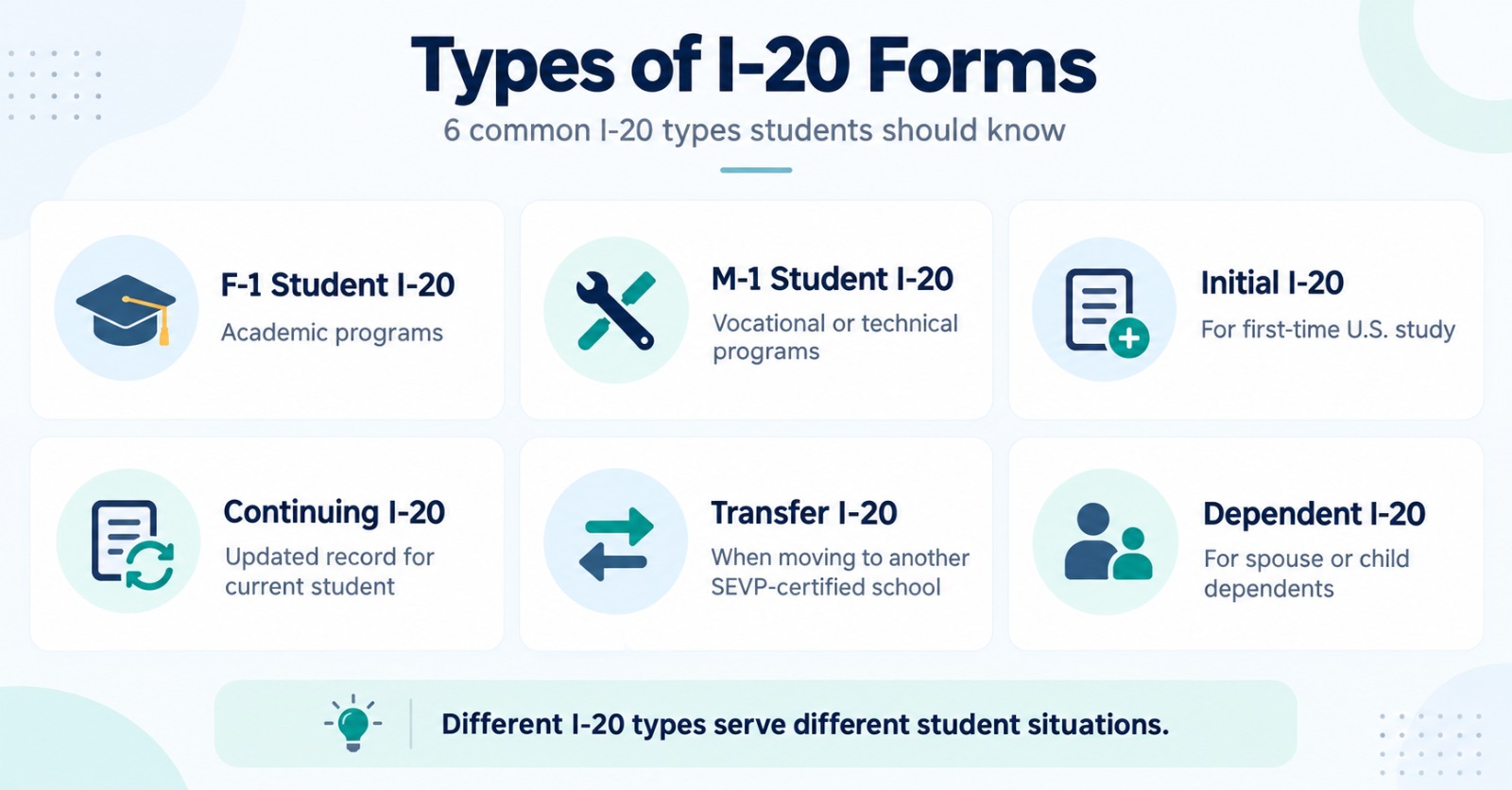
- F-1 Student I-20: For students enrolled in academic programs — universities, colleges, and language training programs. This is by far the most common type.
- M-1 Student I-20: For students in vocational or non-academic technical training programs, such as culinary schools, aviation training, or trade programs.
- Initial I-20: Issued to a student attending a U.S. program for the first time.
- Continuing I-20: Issued to update a currently enrolled student's record — for example, after a change in major, a program extension, or updated funding information.
- Transfer I-20: Issued when a student moves their SEVIS record from one SEVP-certified school to another.
- Dependent I-20: Issued for a spouse or child (F-2 or M-2 dependents) accompanying the primary student, allowing them to apply for a dependent visa.
Why You Need It and What It Requires
At its core, the I-20 exists because the U.S. government wants assurance on three fronts: that the student is enrolling in a legitimate, full-time program; that they can financially support themselves without relying on unauthorized work; and that there is a system in place to track their status throughout their stay.
To be issued an I-20, a student generally needs to have:
- Been formally admitted to a SEVP-certified school
- Confirmed enrollment status (full-time, in most cases)
- Submitted proof of financial ability to cover tuition and living expenses for at least the first year
- Provided passport and biographical information
- Completed any school-specific pre-arrival requirements the DSO needs on file
Eligibility Criteria for Receiving an I-20
Eligibility isn't just about being "accepted" schools and SEVIS have specific boxes that need to be checked before a DSO can issue the form:
-
Acceptance into a full course of study at a school certified by the Student and Exchange Visitor Program (SEVP). Part-time programs generally don't qualify for F-1 status.
-
Proof of financial support covering tuition, fees, and living expenses for at least the first year of study, whether through personal/family funds, scholarships, sponsorships, or a combination.
-
Sufficient academic o English language preparation, verified through transcripts, standardized test scores, or language proficiency exams, depending on the program.
-
A valid passport that will remain valid for the duration of initial entry into the U.S.
-
Intent to pursue a full-time, legitimate program — not a hobbyist or casual course of study.
-
No disqualifying immigration history, such as unresolved status violations from a previous U.S. stay, though individual circumstances vary and are ultimately assessed by consular officers, not the DSO.
-
Evidence to Substantiate that the Student Will Return to the Native Country: US visa officials require solid reasons to believe that the student will return to the home country. To substantiate the intent of returning, the students need to give property documents; parents job details, social proof, or anything substantial that can convince the authorities that the student has sufficient reasons to return to the home country.
Documents Required to Get Your I-20
The documents a DSO needs before generating an I-20 vary slightly between schools, but the essentials are fairly universal:
- Proof of admission - the official offer or acceptance letter from the school
- Passport copy - the biographical page, valid for travel
- Financial documents - bank statements, sponsor letters, scholarship award letters, or loan approval documents showing sufficient funds
- Affidavit of Support (if applicable) - for students relying on a family member or sponsor
- Academic transcripts and certificates - from previously completed education
- Standardized test scores - such as TOEFL, IELTS, GRE, or GMAT, depending on the program
- SEVIS transfer form - only relevant for students transferring from another U.S. school
- Visa/immigration history documents - if the student has previously held a U.S. visa or studied in the U.S. before
Some schools also request a signed financial declaration form specific to their institution, confirming the source and amount of funds available.
How Much Does the I-20 Cost?
The I-20 form itself is typically issued free of charge by the school as part of the admissions process — universities don't usually charge a separate "I-20 fee," though some schools include a small administrative processing charge in their enrollment deposit.
The real cost comes afterward, in the form of the I-901 SEVIS fee, which every prospective F-1 or M-1 student must pay before their visa interview. As of 2026, this fee stands at $350 for F-1 students and $220 for J-1 exchange visitors. It's paid directly to the Department of Homeland Security through the official FMJfee.com portal, never at a consulate or port of entry and the payment receipt must be presented at the visa interview and, again, at the U.S. port of entry.
On top of the SEVIS fee, students should budget for the U.S. visa application fee (the MRV fee), which is separate and paid to the Department of State when scheduling the visa interview.
Step-by-Step: How to Apply for and Receive Your I-20
Step 1: Get admitted
Apply to and receive an official offer of admission from a SEVP-certified school.
Step2: Confirm your enrolment
Accept the offer, pay any required deposit, and notify the school of your intent to enroll.
Step 3: Submit your financial and personal documents
Send passport copies, financial statements, and any required affidavits or sponsor letters to the international student office.
Step 4: Wait for DSO review
The Designated School Official reviews your documents, enters your information into SEVIS, and generates your I-20.
Step 5: Receive and review your I-20
Check every detail carefully — name spelling, date of birth, program dates, and financial figures should all match your actual documents.
Step 6: Sign the I-20
Both the student and the DSO must sign the form; an unsigned I-20 is not valid for visa purposes.
Step 7: Pay the I-901 SEVIS fee
Pay the fees using the SEVIS ID number printed on your I-20.
Step 8: Complete the DS-160 visa application
Complete visa application and schedule your visa interview at a U.S. embassy or consulate.
Step 9: Attend your visa interview
bring your signed I-20, SEVIS fee receipt, financial documents, academic records and other important documents required.
Step 10: Enter the U.S
Enter USA, no earlier than 30 days before the program start date listed on your I-20.
What to Do After Receiving Your I-20
Getting the I-20 isn't the finish line — it's the start of a new checklist:
- Double-check every detail on the form the moment it arrives. Errors in names, dates of birth, or program details can cause delays later, so flag anything wrong to your DSO immediately.
- Keep both digital and physical copies in a safe, easily accessible place — you'll need it again and again, at your visa interview, at the airport, and potentially years later for work authorization or status changes.
- Never let anyone else use or hold your original I-20. It's tied uniquely to your SEVIS record.
- Pay the SEVIS fee promptly, ideally a few business days before your visa interview so the payment has time to register in the system.
- Track your program dates. If your studies get delayed, extended, or you change your major, you must inform your DSO so they can issue an updated I-20, usually within a matter of days of the change.
- Keep old I-20s. Every time a new version is issued, hold onto your previous ones as a paper trail of your immigration history in the U.S.
2026 Updates Related to the I-20 Form
If there's one year to pay extra attention to I-20 and SEVIS news, it's 2026. On July 17, 2026, the Department of Homeland Security published a major final rule that reshapes how long F-1 students and J-1 exchange visitors and foreign media representatives are allowed to stay in the U.S.
Here's what changed, and why it matters:
- Goodbye to open-ended "Duration of Status."
For years, F-1 students were admitted for the entire length of their academic program plus a grace period, with no fixed end date stamped at the border. That flexible system is being replaced with a fixed period of admission, students will now be admitted for a specific timeframe tied directly to the length of the program listed on their I-20, up to a maximum of four years, plus a 30-day grace period before the program starts and another 30 days after it ends. - SEVIS system upgrade
SEVP rolled out SEVIS Release 6.89.1 over the night of September 14–15, 2026, to build the technical functionality needed to support this new fixed-admission structure. - New restrictions on academic mobility
The rule also tightens the rules around transferring schools, changing majors or educational objectives, and moving to a same- or lower-level program once a student's current program is completed. These restrictions apply specifically to programs completed after the rule's effective date of September 15, 2026. - A possible grace period for full rollout
DHS acknowledged that some of these mobility-related provisions may be technically difficult to implement immediately, and reserved the right to delay their enforcement until as late as September 14, 2028, with at least 30 days' advance public notice if it does so. - Extensions now require more paperwork
Students needing to extend their program — for academic, medical, or administrative reasons — must now go through a more clearly defined extension procedure, with DSOs updating SEVIS and issuing a fresh I-20 reflecting the new end date.
For prospective students, the practical takeaway is this: the I-20 you receive in 2026 and beyond isn't just a formality about your program, its start and end dates now more directly determine the exact length of time you're legally allowed to remain in the U.S. Reading those dates carefully, and staying in close contact with your DSO about any changes to your program, matters more than ever.
It's tempting to think of the I-20 as just another bureaucratic hurdle, one more form in a pile of forms standing between a student and their dream of studying abroad. But look at it a little differently, and it becomes something more meaningful: it's the moment a university formally says, "We believe in you, and we're willing to put that in writing for the U.S. government."
Every signature on that page, yours and your DSO's, represents months of preparation, saved-up finances, late-night application sessions, and hope. It's a small document that carries a big promise: the promise of new classrooms, new mentors, new friendships, and a new chapter of life in a country thousands of miles from home.
So, when that email lands in your inbox- "Your Form I-20 is Ready", know that you're not just receiving paperwork. You're holding the key that turns "accepted" into "on my way."
Frequently Asked Questions
Is the I-20 the same as a U.S. student visa?
No. The I-20 is a certificate of eligibility issued by your school that allows you to apply for an F-1 or M-1 student visa. The visa itself is a separate document issued by a U.S. embassy or consulate after your interview.
Can I get an I-20 without proof of full financial support?
Generally, no. Schools require documented evidence — bank statements, sponsor letters, or scholarship confirmations — showing you can cover at least one year of tuition and living expenses before they issue the I-20.
What happens if there's an error on my I-20?
Contact your school's Designated School Official immediately. Even small mistakes, like a misspelled name or wrong date of birth, should be corrected before you use the form for the SEVIS fee payment or your visa interview.
How early can I enter the U.S. with my I-20?
You can enter the United States no more than 30 days before the program start date listed on your I-20.
Do dependents need their own I-20?
Yes. A spouse or child accompanying an F-1 or M-1 student needs their own I-20 (as an F-2 or M-2 dependent) to apply for a dependent visa, though they are not required to pay the I-901 SEVIS fee.