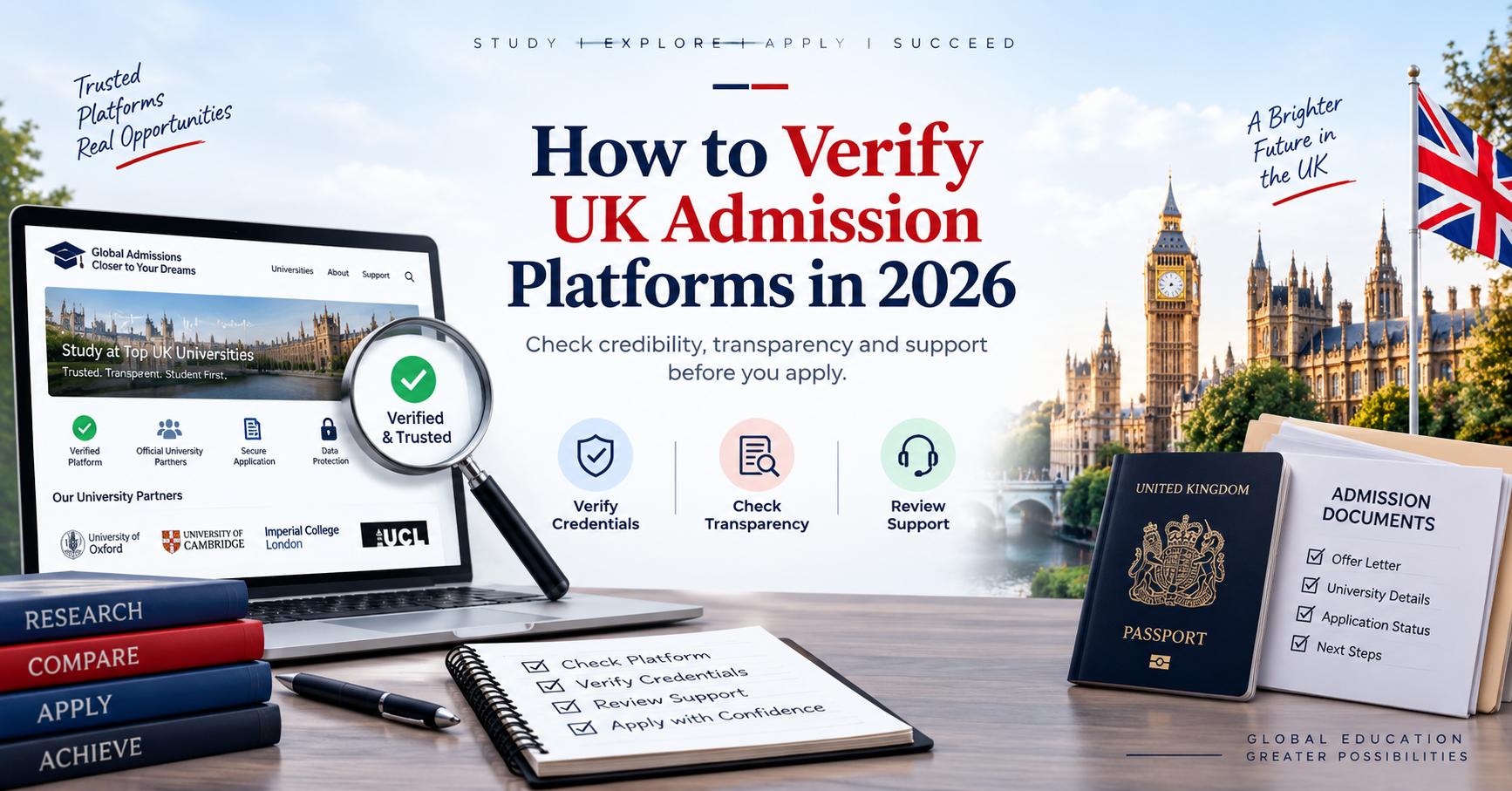
How to Verify UK Admission Platforms in 2026
 Verified read
Verifying a UK university admission platform comes down to three things beyond the marketing page: how deep its university partnerships actually go, how rigorously it verifies applications, and whether its visa support and success rate claims hold up to scrutiny. This is the complete framework for checking all three — plus two supporting factors most comparisons skip — in the order they actually matter.
1. University partnerships: depth over breadth
A platform listing "1,000+ partner universities" sounds impressive but tells you very little about whether it can genuinely support your specific application.
What to check:
- Does the platform partner with your target university directly, or reach it only through a secondary aggregator relationship? Direct partnerships typically mean faster processing and more reliable support if something goes wrong; indirect ones add a layer of delay and reduce accountability.
- How many of the platform's listed universities are in your specific country and subject area, not just its global total? A large network concentrated elsewhere doesn't help you.
- Can the platform name a specific contact or process at your target university, or does it only describe a general relationship? Genuine partnerships come with operational specifics; superficial ones don't.
2. Verified application services: what "verified" should actually mean
This is the category most comparisons skip entirely, despite it being the one most likely to affect whether your application is taken seriously.
What to check:
- What's the actual verification method for transcripts and qualifications — a database cross-check, direct contact with your issuing institution, or just a visual review? These are meaningfully different levels of rigor.
- Is verification consistent across every country the platform serves, or concentrated in its largest markets? Thin coverage outside a platform's top two or three countries is where compliance gaps and preventable refusals cluster.
- Does the platform check whether your SOP, financial documents, and academic history tell a coherent story, or only that each document individually looks complete? This consistency check is increasingly central to how UKVI assesses genuine student applications.
- Is the platform or your specific counsellor accredited under the National Code of Ethical Practice and committed to the Agent Quality Framework (referenced directly in Home Office Student Sponsor Guidance since April 2026)? This is a specific, checkable credential — not a vague reassurance.
3. Visa support and success rate claims
"Visa support" and "success rate" are the two phrases doing the most unverified work in admissions comparisons.
What to check:
- What does visa support actually include — CAS documentation review, financial evidence preparation matched to your target city's threshold, interview preparation — or does support effectively stop once your offer is confirmed?
- If a success rate is quoted, what's the denominator? A rate calculated only on applications the platform chose to submit — after screening out weaker cases — looks very different from one calculated on every applicant who came through the platform.
- Is the rate broken down by your specific country, or blended across a global applicant pool with very different baseline grant rates by nationality?
- Given increased interview scrutiny under current Home Office guidance, does the platform offer preparation specific to explaining a study gap or clarifying financial documentation — not generic advice?
4. How the platform makes money
Nearly every major UK admission platform is free to use because it's paid by universities through commission when a student enrols.
What to check:
- Does commission vary between the universities the platform recommends? A structural incentive worth knowing about, even if it doesn't make the advice untrustworthy.
- What's genuinely free versus what costs extra — SOP editing, interview coaching, and expedited processing are common add-ons that should be disclosed upfront.
5. What happens after you're accepted
The most-tested part of any platform, and the one prospective students hear least about before committing.
What to check:
- What support exists for CAS documentation, pre-departure guidance, and ongoing questions once you've enrolled?
- Is there a named, consistent point of contact, or does support rotate between different people each time you reach out?
Quick reference: the five categories at a glance
| Category | The one question that matters most |
|---|---|
| University partnerships | Does the platform partner directly with your specific target university? |
| Verified application services | Is document verification consistent for your specific country, not just the platform's largest markets? |
| Visa support and success rates | What's the denominator behind any quoted success rate? |
| Business model | Is commission disclosed clearly, including whether it varies by university? |
| Post-acceptance support | Is there a named contact and a stated response time during peak season? |
The one universal red flag
Across all five categories, the same pattern signals a weak platform: an answer that's true in general but not specific to you. "We partner with 1,000+ universities" without confirming your specific one directly. "We have a great success rate" without a denominator. "We verify documents" without naming the method. Specificity is the signal that separates a platform confident in its own process from one relying on reassurance alone.
Frequently asked questions
What does "verified" actually mean for a UK admission platform?
It should mean a specific, checkable process — document and qualification verification, counsellor accreditation under the National Code of Ethical Practice, and consistency checks across your application — not a general label applied without a described method behind it.
How do I check if a platform's visa success rate is meaningful?
Ask what it's calculated against — all inquiries or only submitted applications — and whether it's broken down by your specific country. Baseline visa grant rates already vary substantially by nationality, so a headline percentage without that context tells you very little on its own.
Does the size of a platform's university network matter?
Less than direct partnership depth in your specific target market. A large global total can include many universities reached only through secondary aggregator relationships — ask specifically whether your target university is a direct partnership.
Are UK admission platforms free to use?
Most core application and matching services are free, funded by commission paid by universities upon enrolment. Additional services like SOP editing or expedited processing are often charged separately and should be disclosed clearly before you commit.
What's the most overlooked factor when comparing UK admission platforms?
Post-acceptance support. Most comparisons focus entirely on the application stage, but the moments that matter most — CAS documentation, financial evidence, and a genuine-student interview if you're called for one — happen after you've already committed to a platform, when switching is no longer practical.