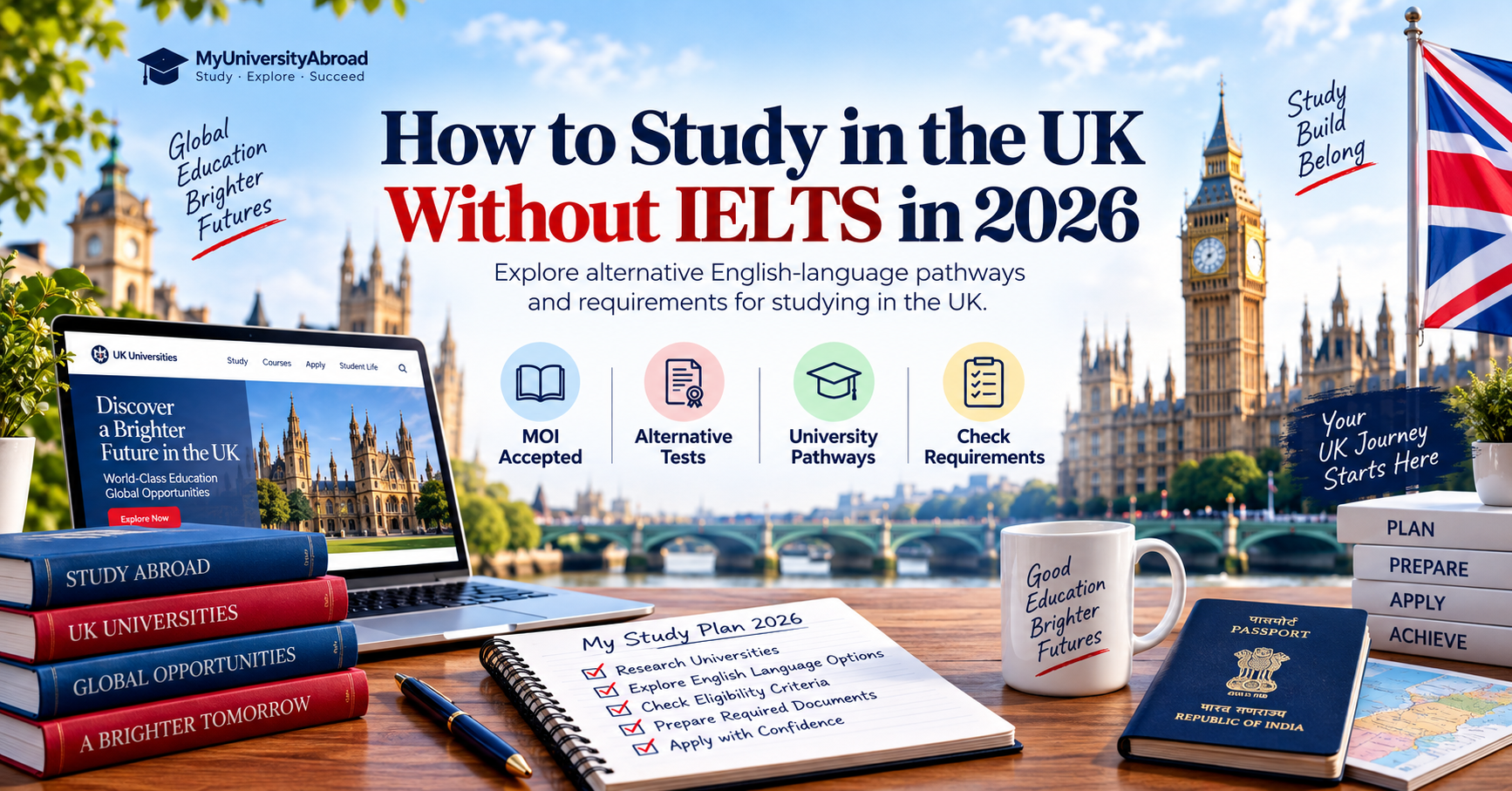
How to Study in the UK Without IELTS in 2026
 Verified read
There are three genuinely distinct ways to study in the UK without sitting IELTS — not one workaround, but three separate routes that suit different students. Confusing them is the most common mistake in this space: a full waiver, an alternative test, and a pre-sessional bridge course all get lumped together as "avoiding IELTS," but they work completely differently and suit different profiles.
The three routes at a glance
| Route | What it involves | Best suited to |
|---|---|---|
| Full waiver (no test at all) | Medium of Instruction certificate, strong Class 12 English marks, or a prior English-medium degree | Students from CBSE/ICSE with strong English marks, or with a prior English-taught qualification |
| Alternative test substitution | Taking PTE, TOEFL, Duolingo, or Cambridge English instead of IELTS | Students who prefer a different test format, faster results, or lower cost |
| Pre-sessional pathway | A short academic English course before your degree starts | Students below their target score who need to close a genuine gap |
Route 1: The full waiver — no test at all
UK universities are UKVI-designated Higher Education Providers with the authority to assess a degree-level applicant's English proficiency themselves, without requiring any test. The most common accepted alternatives:
- Medium of Instruction (MOI) certificate from your previous school confirming English-medium education
- Class 12 English marks, typically 70–75%+ from CBSE or ICSE boards (thresholds vary by university and sometimes by regional board)
- A prior degree taught entirely in English, often sufficient on its own for postgraduate applicants
This route requires no additional test cost or preparation time, but availability varies significantly by university and course — always confirm directly on your target course page rather than assuming it applies universally.
Route 2: Taking a different test instead of IELTS
If a full waiver isn't available for your target course, several other English tests are accepted by many UK universities as a direct substitute for IELTS. Approximate score equivalencies (based on official concordance data from the test providers):
| IELTS | PTE Academic | TOEFL iBT | Duolingo English Test |
|---|---|---|---|
| 6.0 | 50–59 | 60–78 | 95–100 |
| 6.5 | 58–64 | 79–93 | 105–119 |
| 7.0 | 65–72 | 94–101 | 115–129 |
| 7.5 | 73–78 | 102–109 | 130–144 |
Important caveat: these are approximate concordance ranges, not exact conversions, and — critically — most universities publish a specific minimum score for each test individually rather than accepting a mathematically "equivalent" score from a different test. Always check your target course's published requirement for the specific test you plan to take, rather than converting from an IELTS requirement yourself.
A few test-specific notes worth knowing:
- PTE Academic is widely accepted by UK universities and often preferred for its 48-hour turnaround, but note that PTE Academic Online (the remote-proctored version) is not accepted by some universities — only the test-centre version, so check this specifically before booking.
- TOEFL iBT introduced a new 1–6 band scoring scale alongside its legacy 0–120 scale from January 2026, with both scales shown on score reports through a transition period into 2028. Confirm which scale your target university's published requirement refers to.
- Duolingo English Test is accepted by a growing number of UK universities for admission purposes, at a meaningfully lower cost than IELTS, TOEFL, or PTE, with results in around 48 hours. However, Duolingo is not currently on UKVI's approved Secure English Language Test (SELT) list — this only matters if your visa route requires a standalone SELT rather than relying on your university's own CAS-based English confirmation, which is the case for most direct degree-level applicants, but it's worth confirming which pathway applies to you specifically.
- Cambridge English qualifications (like C1 Advanced) are accepted by many universities and don't expire the way other tests do, though universities may still ask for a recency check depending on when you took it.
Route 3: A pre-sessional English course
If your score is meaningfully below your target course's requirement — not just a fraction of a band short — a pre-sessional English course is usually the more reliable path than hoping a different test format produces a better result. These intensive courses typically run 6–20 weeks depending on the size of the gap, often lead into your degree under a single CAS (avoiding a second visa application), and require only a modest starting score (UKVI's own pre-sessional entry threshold sits at CEFR B1, well below degree-level requirements).
Which route actually fits you
- Strong Class 12 English marks or an English-medium background, and confident spoken English: the full waiver route is usually the fastest and cheapest option — check your target university's specific policy first.
- Reasonably strong English but prefer a different test format, faster results, or lower cost: an alternative test substitution is worth exploring, provided you confirm your target course accepts it directly rather than assuming an "equivalent" score transfers automatically.
- Meaningfully below the required standard on any test: a pre-sessional course is the more dependable route, since it's specifically designed to close a real gap rather than work around a technicality.
Frequently asked questions
Can I really study in the UK without ever taking an English test? Yes, if your university accepts a Medium of Instruction certificate, sufficiently strong Class 12 English marks, or a prior English-medium degree in place of a test — this varies by institution and course, so it needs to be confirmed directly rather than assumed.
Is Duolingo accepted for a UK student visa? Duolingo is accepted by a number of UK universities for admission decisions, but it is not currently on UKVI's approved SELT list. For most direct degree-level applicants, this doesn't matter because the university's own CAS-based confirmation satisfies the visa requirement — but it's worth confirming which pathway applies to your specific application.
Does a PTE score of 59 equal an IELTS 6.5? Approximately, based on official concordance data, but universities generally publish separate minimum requirements for each test rather than accepting a converted score. Always check your target course's specific PTE requirement rather than converting from its published IELTS figure yourself.
What if my score is close but not quite at my target university's requirement? For a small gap (around half a band), consider whether a different test format might suit your strengths better, or check if a single-skill retake is available. For a larger gap, a pre-sessional English course is generally the more reliable route than repeatedly retesting.