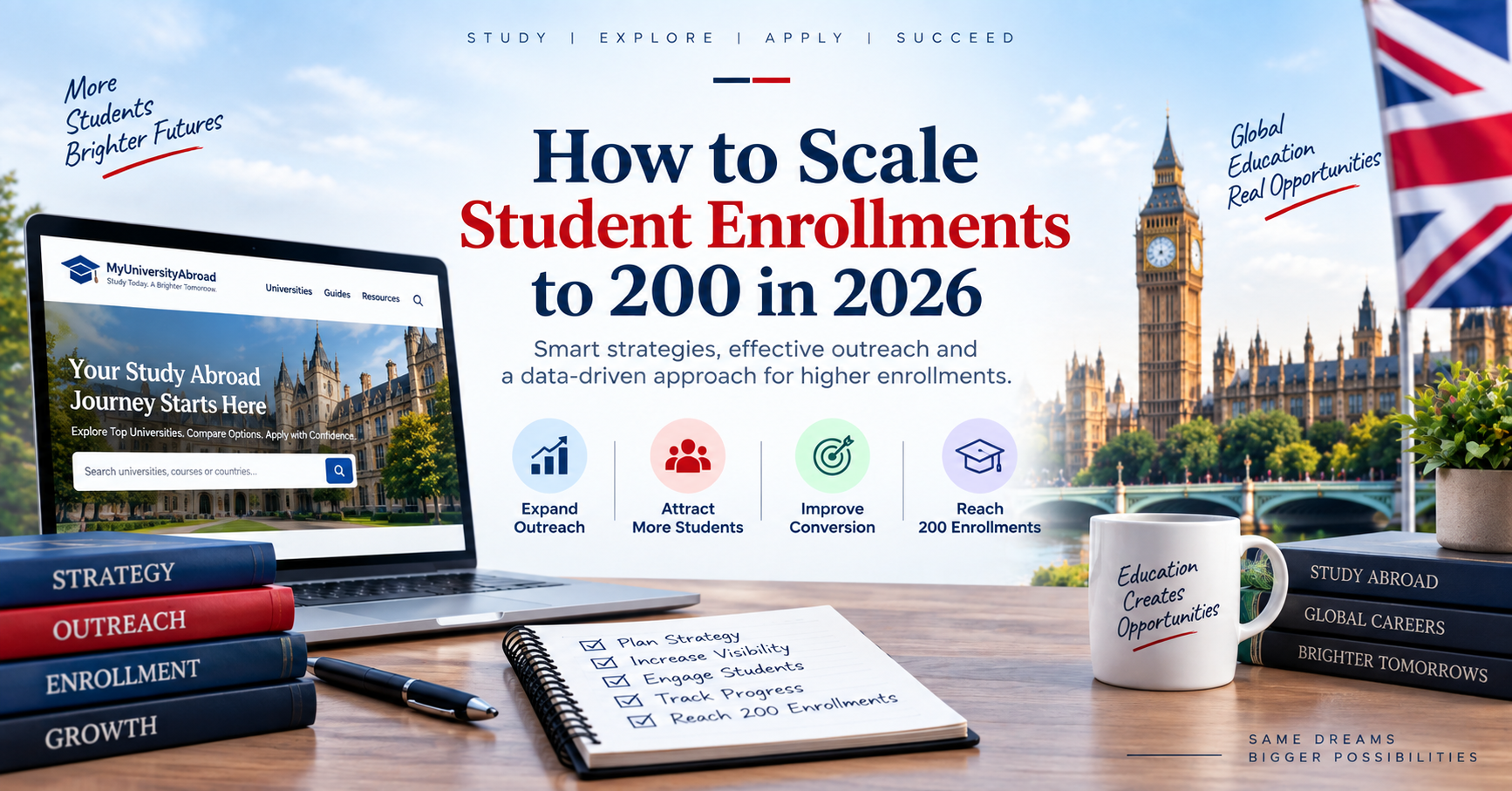
How to Scale Student Enrollments to 200 in 2026
 Verified read
Recruitment agencies scaling from 50 to 200 enrollments face a different problem than universities scaling their own intake: you're managing counsellor capacity, commission tracking, and compliance standing across multiple partner institutions simultaneously, not one admissions pipeline. Growing student volume faster than your process can handle isn't just an efficiency problem here — it's a reputational one, since a spike in refusals or compliance issues affects your standing with every partner university at once, not just one intake cycle.
Why agency growth breaks differently than institutional growth
A university scaling its own intake manages one admissions process. A recruitment agency managing 200 students across a dozen partner universities is managing a dozen sets of requirements, commission structures, and compliance expectations simultaneously. The bottleneck that breaks first is usually counsellor capacity to maintain quality across that variety, not raw application-processing volume.
Standardize before you scale
One intake process regardless of destination university. Even though each partner institution has different requirements, your internal workflow for collecting documents, checking eligibility, and preparing applications should follow one standard process with institution-specific variations layered on top — not a completely different process per partner. This is what lets a counsellor handle applications across multiple universities without relearning a process for each one.
Standardized SOP and financial document review checklists. Genuine student assessment increasingly hinges on whether an applicant's SOP, financial evidence, and academic history tell a consistent story — building this consistency check into your standard workflow, rather than leaving it to individual counsellor judgment, protects your refusal rate as volume grows across more counsellors and more students.
One accreditation and training standard for every counsellor, regardless of how quickly you're hiring. Since April 2026, Home Office Student Sponsor Guidance directly references the Agent Quality Framework for institutions using recruitment agents — meaning your own counsellors' National Code and AQF accreditation status is now something partner universities actively verify, not something they take on trust. Scaling headcount without scaling this credentialing in parallel creates a real partnership risk.
Automate the volume, not the judgment
CRM-based tracking across every partner university, not a spreadsheet per institution. A single source of truth for where every student sits in their application — regardless of which university — is what lets counsellors handle more students without losing track of individual cases.
Automated status updates for routine questions. Deadline reminders, document checklists, and general process questions can be automated, freeing counsellor time for the conversations that actually require judgment — course selection guidance, addressing a complicated academic history, or preparing a student for a visa interview.
Commission and compliance tracking by partner university, automated rather than manually reconciled. As you scale, manually tracking which students are with which university, at what commission rate, becomes error-prone fast. Automating this from early on prevents a scaling-stage reconciliation problem that's expensive to unwind later.
Capacity planning: the counsellor-to-student ratio that actually holds
The naive assumption is that 4x student volume needs 4x counsellors. In practice, the ratio that holds depends on how much of the current counsellor workload is routine versus judgment-based:
- If most counsellor time currently goes to document chasing and status updates (routine, automatable work), standardizing and automating this can let existing counsellors absorb meaningfully more volume before a new hire is needed.
- If most counsellor time goes to genuine guidance — course selection, complex academic profiles, interview preparation — headcount needs to scale closer to proportionally, since this is exactly the work that shouldn't be automated away.
Audit your current team's actual time allocation before assuming either extreme; most agencies sit somewhere in between, with more routine-task time recoverable through automation than owners initially assume.
The costly mistakes that actually derail agency growth
Scaling student volume faster than verification capacity. A spike in refusal rate — even from ordinary growing pains rather than genuine fraud — damages your standing with every partner university simultaneously, since your agency-level refusal rate is something universities increasingly track as part of their own RAG compliance exposure.
Adding junior counsellors without parallel quality control. A new counsellor handling applications without the same consistency-checking discipline as your experienced staff is how quality dilution happens invisibly — it shows up as a refusal-rate increase months later, not as an immediate, visible problem.
Losing commission and compliance visibility as partner university count grows. Manually tracking a growing number of institutional relationships, each with different commission structures and reporting requirements, is a common source of costly errors — both financial and reputational — once volume passes a certain point.
Overpromising capacity to partner universities beyond what your process can actually support. Committing to a volume target with a partner institution before confirming your own operational capacity can handle it creates pressure that leads directly to the first two mistakes above.
Frequently asked questions
How many counsellors do I need to scale from 50 to 200 students?
It depends on how much of your current counsellor time is routine (automatable) versus judgment-based. Agencies that standardize intake and automate status updates typically need fewer additional counsellors than a naive proportional estimate suggests; audit your team's actual time allocation before assuming a fixed ratio.
Why does scaling too fast increase visa refusal risk for a recruitment agency?
Rapid growth without parallel investment in consistency checking (SOP, financial documents, and academic history telling a coherent story) and counsellor training tends to introduce quality gaps that surface as refusals — which affects your agency's standing with every partner university, not just the affected applications.
Does the Agent Quality Framework affect how I scale my counsellor team?
Yes. Since April 2026, partner universities are expected to confirm their agents are AQF-committed, meaning every counsellor you add needs to be brought up to the same accreditation standard as your existing team — hiring quickly without maintaining this in parallel creates a compliance gap partner institutions increasingly check for.
What's the first thing to fix before scaling enrollment volume?
Standardizing intake and document collection across all partner universities, since this is typically where the largest hidden time cost sits and where inconsistency most directly affects your agency's refusal rate as volume grows.