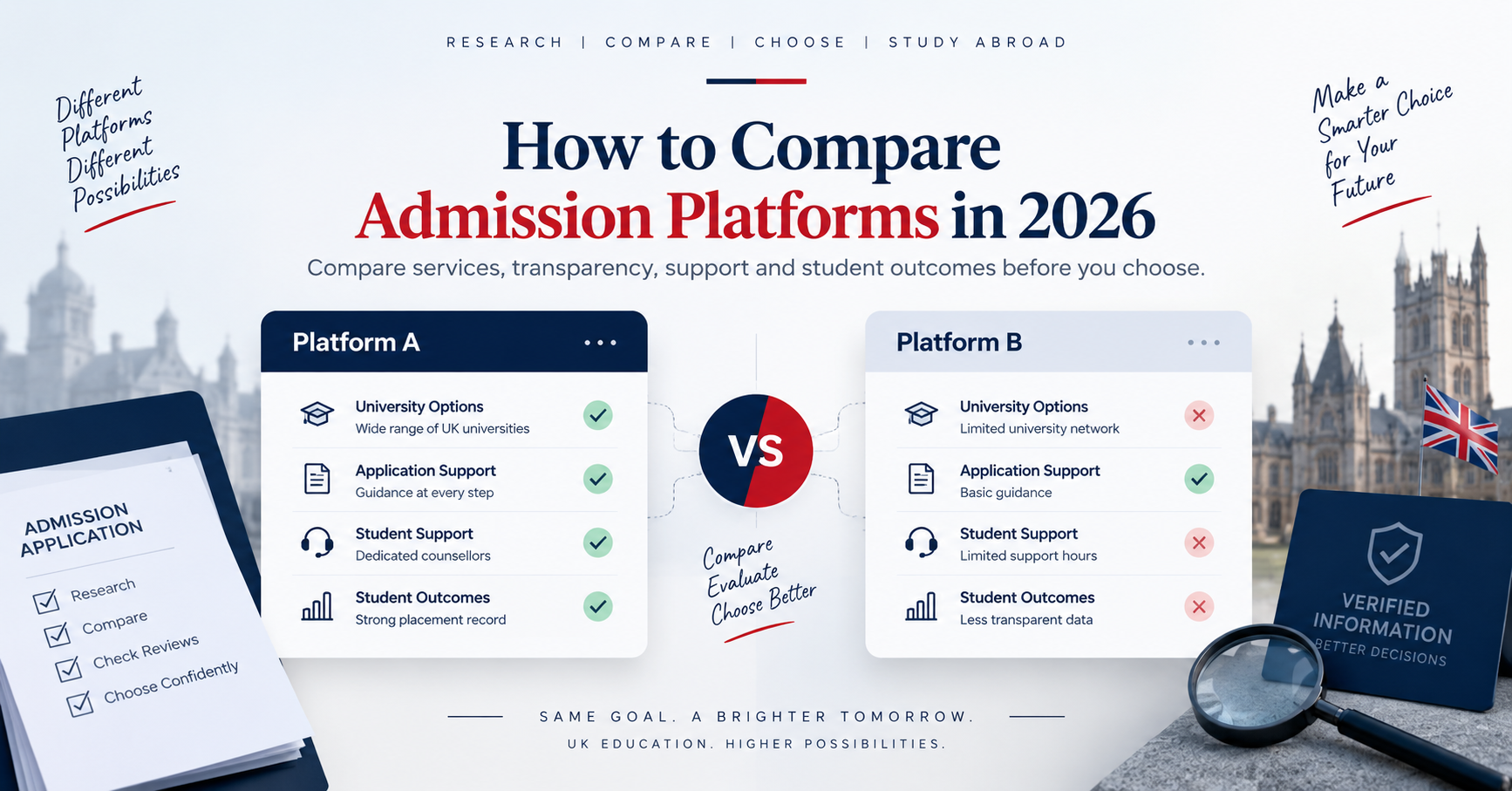
How to Compare Admission Platforms in 2026
 Verified read
Imagine two visa support platforms side by side. One prominently promotes a 98% visa success rate. The other never mentions a success percentage, but clearly explains what happens if a visa officer questions your financial documents and how such cases are handled. Most students would instinctively choose the first. In reality, the second may be the more reliable option. The real skill in comparing visa platforms isn't memorising a checklist—it's recognising which platform prioritises transparency over marketing claims.
The trouble with leading with a number
A success rate is the easiest thing for a platform to advertise and the hardest thing for a student to verify. It can be entirely true and still tell you almost nothing useful, because it depends on questions the headline never answers: success measured against how many total inquiries, over what period, for applicants from which countries? A platform that quietly filters out weaker cases before submission will naturally post a stronger number than one that takes on every applicant who walks through the door and that filtering isn't dishonest, it's just invisible in the marketing.
So rather than starting with the number, start with three things that are actually testable.
First: does the visa support hold up under a real scenario, not just a sales pitch?
Ask a platform what it does when an applicant's finances look slightly unusual — a large deposit a few weeks before the required 28-day window, say, or a sponsor who isn't a parent. A platform with genuine visa expertise will describe a specific process: flag it early, gather supporting documentation, prepare the applicant to explain it clearly if asked. A platform without that depth will either dodge the question or repeat the same success-rate line. The scenario test reveals more in thirty seconds than a homepage does in ten minutes.
The same logic applies to interview preparation. With credibility interviews becoming more common under current Home Office practice, a platform that can walk you through how to explain a study gap or clarify a financial document — specifically, not generically — is telling you something real about its actual capability.
Second: is the money story straightforward, or does it require follow-up questions to understand?
Almost every platform in this space is paid by the institution you enrol with, not by you directly, which is why the core service usually feels free. That's completely normal. What separates a transparent platform from an evasive one is whether it volunteers this, and whether it tells you plainly if that payment varies depending on which university you choose. A platform that answers "how are you paid" in one clear sentence is a different kind of business than one that needs three follow-up questions to get a straight answer.
Worth checking too: whether commission is worked out on the fee you'll actually pay after any scholarship, or the full advertised price — a detail that shapes how much a specific offer is actually worth to the people advising you.
Third: does the platform actually know what fits you, or does it know what fits its catalogue?
This is the hardest one to test but arguably the most important. A platform built around genuine fit will ask about your background, your goals, and your realistic academic profile before making a recommendation — and it should be able to explain that recommendation in terms specific to you, not a generic pitch about "top-ranked" or "high-demand" programmes. If you ask why a particular course was suggested and the answer could apply to almost any student, that's a signal the recommendation engine is optimising for something other than your actual fit.
Putting the three together
None of these three replace due diligence on the basics — verification standards, compliance accreditation, what happens after you're accepted. But they cut through the part of platform comparison that tends to waste the most time: chasing a single headline number that was never designed to answer the question you actually care about, which is simply: will this platform genuinely help my application, specifically, succeed.
Frequently asked questions
Why shouldn't I trust a platform's advertised visa success rate?
Not because it's necessarily false, but because it usually answers a narrower question than it appears to — often reflecting a screened group of applicants rather than everyone who approached the platform, and rarely broken down by country, where baseline outcomes vary substantially anyway.
What's a better question to ask than "what's your success rate"?
Ask the platform to walk through a specific scenario — an unusual bank deposit, a study gap, a possible credibility interview and see whether the answer is a described process or a repeated marketing line.
How can I tell if a platform's course recommendation genuinely fits me?
Ask why a specific course was suggested. A genuine answer references your actual background and goals; a generic answer could apply to almost any applicant, which suggests the recommendation wasn't really built around you.
Do all visa application platforms charge students directly?
Most don't for the core service, since they're paid by the institution upon enrolment, but ask directly whether any additional services (interview coaching, document editing) carry a separate cost, since this varies and should be disclosed upfront.