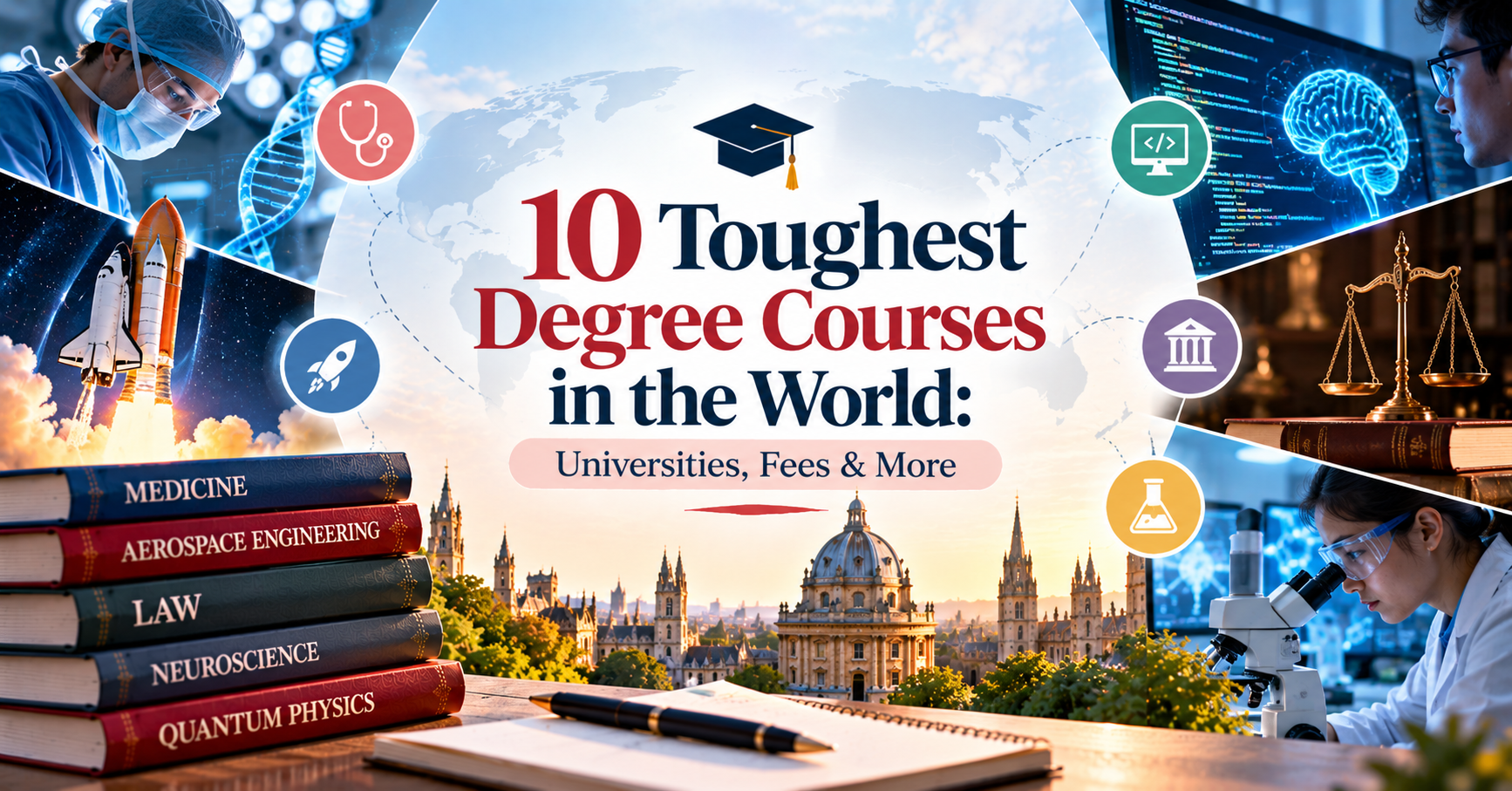
10 Toughest Degree Courses in the World: Universities, Fees & More
 Verified read
Somewhere in a dimly lit library in Boston, a first-year medical student is re-reading the same page of a physiology textbook for the third time, chasing sleep that keeps slipping further away. Across the Atlantic, in a wind-tunnel lab in Toulouse, an aerospace engineering undergraduate is recalculating a lift coefficient for the fourth time because the numbers refuse to make sense at 2 a.m. In Bangalore, a Chartered Accountancy aspirant stares at a pass percentage that hovers in single digits, wondering if this is the attempt that finally works out.
These are not scenes from an exaggerated drama. They are an ordinary Tuesday night for thousands of students who have chosen to walk into the hardest classrooms on the planet. Every generation produces its own mythology around "the toughest degree" the one that separates the merely intelligent from the truly relentless. But toughness, as it turns out, is not a single ingredient. It is a cocktail of abstract theory, brutal competition, physical exhaustion, financial pressure, and the sheer weight of responsibility that some fields place on the shoulders of the young people studying them.
This blog is a tour through ten such degrees, the ones that routinely appear at the top of "hardest in the world" lists compiled by universities, career counsellors, and the students who lived to tell the tale. We will look at what makes them formidable, where in the world you can study them, what they cost, and — just as importantly — why so many people still choose to sign up for the struggle.
What Actually Makes a Degree "Tough"?
Before diving into the list, it helps to understand the ingredients that push a degree into the "hardest" category. Difficulty rarely comes from one factor alone; it is usually a layered combination of the following:
1. Conceptual and mathematical complexity. Degrees built on abstract, counter-intuitive ideas, quantum mechanics, tensor calculus, and organic reaction mechanisms demand a kind of thinking that cannot be memorized. You either build the mental model, or the subject stays permanently out of reach.
2. Volume of content. Some fields are hard not because any single concept is impossible, but because there is an overwhelming amount of it. Medicine is the textbook example: an average curriculum can involve tens of thousands of new terms, structures, and drug names to internalize before a student ever touches a patient.
3. Length and intensity of the program. A three-year degree and a fifteen-year path to full specialization are simply different kinds of commitment. Fields like medicine and architecture stretch across years of coursework followed by additional years of licensing, residency, or apprenticeship.
4. Competitive entry and attrition. Acceptance rates in the single digits, brutally low pass rates on professional exams, and high dropout rates all signal a filtering system designed to admit and retain only those who can sustain the pace.
5. High-stakes responsibility. When mistakes have irreversible human consequences in surgery, in aircraft design, in structural engineering, the psychological weight of the coursework increases dramatically, even before accounting for its technical difficulty.
6. Physical and mental endurance. Sleep-deprivation statistics among architecture and medical students are not urban legend; they reflect study schedules that regularly stretch past 60–80 hours a week during peak semesters.
7. Grading rigor and subjectivity. Fields like architecture and fine arts add another layer of difficulty: there often isn't a single "correct" answer, and work is judged by critique, portfolio review, or juried assessment rather than an objective answer key.
The Perks of Choosing the Hard Path
If these degrees are so punishing, why do ambitious students keep lining up for them? Because the reward structure, more often than not, matches the difficulty.
- Higher earning potential. Fields like medicine, aerospace engineering, actuarial science, and chartered accountancy consistently rank among the highest-paying career tracks worldwide, often with salaries that grow steeply after the initial qualification period.
- Global portability. A medical license, an engineering degree, or a CA/CPA qualification tends to be recognized, sometimes with minor bridging requirements across borders, making these degrees a passport to international careers.
- Job security and demand. Skilled surgeons, aerospace engineers, and data scientists are rarely unemployed for long; scarcity of qualified talent works in the graduate's favour.
- Intellectual prestige and personal growth. Surviving a demanding curriculum builds a resilience and problem-solving muscle that tends to serve graduates well beyond their original field, even if they eventually pivot careers.
- Meaningful, high-impact work. Few feelings compare to diagnosing a rare illness correctly, watching a structure you engineered withstand real-world stress, or seeing a spacecraft you helped design leave the atmosphere.
- A built-in professional network. The shared suffering of a brutal cohort creates unusually strong alumni bonds, something graduates of these programs mention again and again as a lifelong asset.
With that context in mind, here is the list.
The 10 Toughest Degrees in the World
1. Medicine (MBBS/MD) Medicine sits at the top of almost every "hardest degree" ranking, and for good reason. Students must absorb an enormous volume of materials like anatomy, physiology, biochemistry, pharmacology, pathology, and more while also developing hands-on clinical skill and emotional resilience for life-and-death situations. The path from enrollment to full specialization can stretch past a decade once residency and fellowship are included, and study weeks of 60–80 hours are common.
Specializations: Internal Medicine, Surgery, Pediatrics, Cardiology, Neurology, Oncology, Psychiatry, Radiology, Obstetrics & Gynaecology, Anaesthesiology.
Best universities: Harvard Medical School (USA), University of Oxford Medical School (UK), Johns Hopkins University (USA), University of Cambridge (UK), Karolinska Institute (Sweden), All India Institute of Medical Sciences – AIIMS (India).
Best country to study: The United States and the United Kingdom remain the gold standards for research-driven medical training, though countries like Australia, Canada, and Germany offer excellent, more affordable alternatives with strong international recognition.
Approximate tuition: US MD programs typically run USD 55,000–70,000 per year at private schools; UK medical degrees cost roughly GBP 30,000–58,000 per year for international students; countries like Germany and several government medical colleges in Asia offer substantially subsidized or near-free options for eligible students.
2. Aerospace Engineering
Aerospace engineering blends advanced physics, fluid dynamics, propulsion theory, structural mechanics, and control systems into a single discipline where a small calculation error can have catastrophic real-world consequences. Because the work directly touches public safety, the coursework is designed to leave essentially no room for approximation.
Specializations: Aerodynamics, Avionics, Propulsion Systems, Spacecraft Design, Structural and Materials Engineering, Flight Mechanics.
Best universities: Massachusetts Institute of Technology (USA), Caltech (USA), Stanford University (USA), Imperial College London (UK), Technical University of Munich (Germany), Indian Institute of Technology Bombay (India).
Best country to study: The United States dominates this field thanks to its ties with NASA, Boeing, and SpaceX-adjacent research ecosystems, though France and Germany are strong choices for those interested in Airbus-linked aerospace programs.
Approximate tuition: USD 50,000–60,000 per year at top private US universities; considerably lower (around EUR 3,000–20,000 per year) at public universities in Germany and France for international students.
3. Quantum Physics
Quantum physics asks students to abandon classical intuition altogether. Concepts like superposition, entanglement, and wave-particle duality cannot be visualized the way everyday physics can, and the mathematics including operator theory, complex analysis, and advanced linear algebra is genuinely graduate-level even for advanced undergraduates.
Specializations: Quantum Computing, Quantum Optics, Condensed Matter Physics, Particle Physics, Quantum Field Theory.
Best universities: University of Cambridge (UK), Caltech (USA), ETH Zurich (Switzerland), University of Tokyo (Japan), Princeton University (USA).
Best country to study: Switzerland and the UK are renowned for theoretical physics pedigree, while the US leads in quantum computing research funding and industry partnerships.
Approximate tuition: USD 45,000–58,000 per year in the US; CHF 1,500–4,000 per year at Swiss public universities (remarkably affordable relative to program prestige); UK fees for international students typically fall between GBP 25,000–38,000 per year.
4. Chartered Accountancy (CA)
Unlike a conventional university degree, Chartered Accountancy is a professional qualification built around a series of notoriously difficult exams. In markets like India, the CA Final exam has historically recorded pass rates as low as 10–15%, and candidates often need multiple attempts spread over several years while simultaneously completing mandatory articleship training.
Specializations: Auditing, Taxation, Corporate Finance, Forensic Accounting, International Financial Reporting.
Best providers: The Institute of Chartered Accountants of India (ICAI), ICAEW (England and Wales), CPA Australia, ACCA (UK-based, globally recognized).
Best country to study: The UK and Australia offer globally portable qualifications (ACCA, CPA Australia) with somewhat friendlier pass rates, while India's ICAI route is prestigious but famously demanding.
Approximate tuition: Relatively affordable compared to university degrees — ICAI's total course fees run to a few thousand US dollars, while ACCA and CPA Australia programs typically cost USD 3,000–8,000 across all exam levels, excluding tuition support and coaching.
5. Architecture
Architecture demands an unusual dual competency like rigorous technical knowledge of structures, materials, and building codes, combined with creative design sensibility that is judged subjectively through studio critiques and portfolio reviews. Students frequently pull all-nighters before submission deadlines, and US survey data has placed architecture students among the most sleep-deprived of any major, averaging around 5.28 hours of sleep per night.
Specializations: Urban Design, Landscape Architecture, Sustainable/Green Architecture, Interior Architecture, Structural Design.
Best universities: Massachusetts Institute of Technology (USA), ETH Zurich (Switzerland), University College London – The Bartlett (UK), Delft University of Technology (Netherlands), Politecnico di Milano (Italy).
Best country to study: Italy and the Netherlands offer rich architectural heritage and design culture at relatively accessible tuition, while the US and UK remain top choices for cutting-edge research and global firm recruitment.
Approximate tuition: USD 50,000–58,000 per year in the US; EUR 2,000–20,000 per year at public European universities depending on country and residency status.
6. Law (LLB/JD)
Law degrees require mastering dense, precisely worded material and applying it through rigorous logical argument often under intense time pressure during moot courts and exams. The Socratic method used in many law schools, especially in the US, is designed to be intellectually punishing, and competition for top firms and clerkships remains fierce even after graduation.
Specializations: Corporate Law, Constitutional Law, Criminal Law, Intellectual Property Law, International Law, Human Rights Law.
Best universities: Yale Law School (USA), Harvard Law School (USA), University of Oxford (UK), University of Cambridge (UK), National Law School of India University – NLSIU (India).
Best country to study: The US remains the benchmark for corporate and constitutional law training, while the UK offers a shorter, more affordable route into a globally respected legal tradition.
Approximate tuition: US JD programs commonly cost USD 55,000–70,000 per year; UK LLB tuition for international students ranges roughly GBP 20,000–35,000 per year.
7. Pharmacy
Pharmacy programs blend chemistry, biology, and pharmacology at a depth comparable to pre-medical coursework, layered with extensive practical training in drug interactions, dosage calculations, and patient counselling. A single computational or dispensing error carries real clinical risk, which keeps the grading and clinical assessment standards extremely strict.
Specializations: Clinical Pharmacy, Pharmaceutical Chemistry, Pharmacology, Industrial Pharmacy, Hospital Pharmacy.
Best universities: University College London School of Pharmacy (UK), University of Michigan (USA), Monash University (Australia), University of Toronto (Canada).
Best country to study: The UK and Australia are especially popular for their structured registration pathways (GPhC and AHPRA respectively) that lead directly into licensed practice.
Approximate tuition: GBP 20,000–30,000 per year in the UK for international students; AUD 40,000–48,000 per year in Australia.
8. Neuroscience
Neuroscience sits at the crossroads of biology, chemistry, physics, psychology, and computer science, asking students to understand the brain from molecular signalling all the way up to cognition and behaviour. The interdisciplinary breadth means there is rarely a "safe" area to specialize in early, students are expected to be competent across wildly different scientific languages.
Specializations: Cognitive Neuroscience, Computational Neuroscience, Neurobiology, Behavioural Neuroscience, Clinical Neuropsychology.
Best universities: University College London (UK), Massachusetts Institute of Technology (USA), Stanford University (USA), University of Cambridge (UK).
Best country to study: The UK and US lead in neuroscience research infrastructure and funding, offering unmatched access to brain-imaging labs and clinical research hospitals.
Approximate tuition: USD 50,000–60,000 per year in the US; GBP 25,000–35,000 per year in the UK.
9. Astrophysics
Astrophysics requires the same mathematical firepower as quantum physics, multivariate calculus, statistical mechanics, and relativity but layered onto cosmological scales that are nearly impossible to test directly in a lab. Students must build strong intuition for phenomena they can never observe firsthand, relying instead on simulation, inference, and painstaking data analysis from telescopes and satellites.
Specializations: Cosmology, Observational Astronomy, Astroparticle Physics, Planetary Science, Stellar Astrophysics.
Best universities: California Institute of Technology (USA), University of Cambridge (UK), Max Planck Institute-affiliated programs (Germany), Australian National University (Australia).
Best country to study: The US and Germany offer exceptional research infrastructure through partnerships with observatories and space agencies, while Australia provides unique access to Southern Hemisphere sky observation.
Approximate tuition: USD 45,000–55,000 per year in the US; largely tuition-free or nominal fees (a few hundred euros per semester) at many German public universities for international students.
10. Computer Science (with a specialization in Artificial Intelligence / Machine Learning)
While a general computer science degree is manageable, the AI/ML specialization track has become one of the fastest-evolving and most mathematically intense areas in modern academia. It demands fluency in linear algebra, probability theory, and optimization, alongside constantly shifting research literature, making it difficult for coursework to ever feel fully "settled."
Specializations: Machine Learning, Natural Language Processing, Computer Vision, Robotics, Data Science, Cybersecurity.
Best universities: Massachusetts Institute of Technology (USA), Carnegie Mellon University (USA), Stanford University (USA), University of Cambridge (UK), ETH Zurich (Switzerland).
Best country to study: The United States remains unmatched for AI research funding and access to leading tech companies, though Switzerland and Canada are increasingly strong, well-funded alternatives.
Approximate tuition: USD 55,000–60,000 per year at top private US universities; CHF 1,500–4,000 per year at Swiss public universities; CAD 30,000–45,000 per year in Canada for international students.
There is a peculiar kind of satisfaction that only comes from surviving something genuinely difficult, not the manufactured difficulty of busywork, but the real kind that tests whether you can keep showing up when the material refuses to make sense and the finish line keeps moving. Every student profiled in every "hardest degree" ranking eventually crosses that finish line the same way: not through raw genius, but through the quiet, repeated decision to try again tomorrow.
If you are standing at the edge of one of these ten degrees, wondering whether you have what it takes, remember this: nobody who has completed a medical residency, defended a physics thesis, or passed the CA Final on a tough attempt started out as a finished expert. They started as beginners who were willing to be confused for a very long time before things finally clicked. Choose a hard degree not because it looks impressive on paper, but because the subject genuinely pulls at your curiosity. That pull is what will get you through the 2 a.m. study sessions long after motivation alone has run out.
The world needs people willing to do the hard, unglamorous work of mastering difficult things — the surgeons, the structural engineers, the physicists chasing the next discovery. If that's you, the difficulty is not a warning sign to turn back. It's the description of the exact skill being built.
Frequently Asked Questions
1. What is the single hardest degree in the world?
There is no universally agreed "hardest" degree, but Medicine (MBBS/MD) is the most frequently cited answer due to its combination of an enormous syllabus, long duration (often 10–15 years to full specialization), high-stakes clinical responsibility, and highly competitive admissions at top schools.
2. Are these tough degrees worth pursuing given the difficulty and cost?
For most graduates, yes — fields like medicine, aerospace engineering, law, and chartered accountancy consistently rank among the highest-paying and most globally portable career paths, which tends to offset the years of demanding study and, in many cases, significant tuition investment.
3. Which of these degrees is best for someone strong in mathematics but not biology?
Quantum Physics, Astrophysics, and Aerospace Engineering are ideal for mathematically inclined students, as they lean heavily on calculus, linear algebra, and physics rather than biological sciences.
4. Do I need to be naturally brilliant to succeed in these programs?
Not necessarily. Most graduates of even the toughest programs were not exceptional at everything when they started; sustained effort, genuine curiosity, and resilience tend to matter more than raw intelligence, provided a student has the foundational strength the subject requires.
5. Which country offers the most affordable path into these tough degrees?
Germany and Switzerland stand out for offering world-class programs in physics, engineering, and computer science at little to no tuition cost for international students at public universities, making them excellent choices for students seeking rigor without the steep US or UK price tag.